Walter & Group.....
From Chase Jablonski on knots:
Hey Gordy and Group,
I view the Uni Knot as a concept which may be
used in many different ways, from snelling a hook to a fly line to leader knot.
One of my favorite uses is for the Double Uni Knot, in which two Uni Knots slide
into each other, tying two lines together like a blood knot. This is a great
knot for lines of varying diameter or for super braid to mono. My point is, that
even though a Double Uni Knot slips until it tightens, it's still just two Uni
Knots. The Duncan's Loop is the same thing; tightening it does not make it a new
knot. I could do the same thing with any number of knots. If I leave a Clinch
Knot only partially tightened is it a different knot? I don't think so. I do
suspect that the slipping nature of the Duncan's Loop has the tendency to
decrease the breaking strength of the line being slipped upon,
however.
Cheers.
~~~~~~~~~~~~~~~~~~~~~~~~~~~~~~~~~~~~~~~~~~~~~~~~~~~~~~~~~~~~~~~~~~~~~~~~~~~~~~~~~~~~~~~~~~~
Chase .. I agree on all counts. Strength is not a problem when used for the loop (s) in the heavier segments of the leader. Firstly, the tippet breaks first. Second; the uni loops higher up on the leader usually don't slip down. It's when they slip that they are more likely to break.
Lefty's knot studies are extensive. He has concluded that all knots slip just before they break. He may well be correct about that.
I had two uni loops in my leader 3 days ago when I caught a tarpon which taped out at 130 lbs. (Also used a new variation on a Bimini Twist by Lewis Hinks. More on that one, later.)
Gordy
~~~~~~~~~~~~~~~~~~~~~~~~~~~~~~~~~~~~~~~~~~~~~~~~~~~~~~~~~~~~~~~~~~~~~~~~~~~~~~~~~~~~~
Spey & Roll casts
~~~~~~~~~~~~~~~~~~~~~~~~~~~~~~~~~~~~~~~~~~~~~~~~~~~~~~~~~~~~~~~~~~~~~~~~~~~~~~~~~~~~
Ally's answer to the question of placement of the anchor :-
``````````````````````````````````````````````````````````````````````````````````````````````````````````````````````````````````````````````````````````````
Jim.... I wasn't aware that
proper anchor placement included the choice of placement of the fly
behind the caster.
Let's ask our THCI's about that one.
Gordy
~~~~~~~~~~~~~~~~~~~~~~~~~~~~~~~~~~~~~~~~~~~~~~~~~~~~~~~~~~~~~~~~~~~~~~~~~~~~~~~~~~~~~~~~
Proper anchor placement is in front of a line drawn across the body and through the casters shoulders. Shoulders rotate and so this line rotates. If the anchor is behind this line the D loop cannot be fully supported by the rod tip and is likely to collapse. Of course it is possible on seeing that happen to speed up and deliver the cast just as it is possible to make a less than perfect back cast and compensate. A caste of two wrongs making a right! Whether an anchor appears to be behind the caster or not depends on where you are looking from!
Best
wishes,
Ally Gowans
~~~~~~~~~~~~~~~~~~~~~~~~~~~~~~~~~~~~~~~~~~~~~~~~~~~~~~~~~~~~~~~~~~~~~~~~~~~~~~~~~~~~~~~~~~~~~~~~~~~~~
Ally.... Interesting way of looking at it ! Gordy
~~~~~~~~~~~~~~~~~~~~~~~~~~~~~~~~~~~~~~~~~~~~~~~~~~~~~~~~~~~~~~~~~~~~~~~~~~~~~~~~~~~~~~~~
From Pete Humphreys:
Hi
Gordy,
Gosh lots of words
about what amounts to very little because the roll cast family is really not so
complicated.
There is the strict
definition of the roll cast which is what many of us call the basic roll cast,
let us not get fixated by it. Then there is the possibility to make other types
of roll cast dynamically, two forms exist. Both forms require a D loop and an
anchor of minimum water contact compatible with sufficient resistance to allow
the caster to load the rod against a mass of line in the D loop.
With the first form
(Picked Up), whether or not the rod is stopped at the rear extremity the object
is to clear (lift) as much line as possible from the water and into the D loop
prior to completing the cast. There is no possibility to make a large change of
direction and if a change of direction is required it is made by prior
repositioning the line – line layout would be the FFF term for this I think and
the cast is completed with the roll cast element, usually dynamic. So the cast
is made by picking up as much line as possible in the air to form a D loop –
minimising water contact – and completing the cast. Various casts use this
simple “pick up and go” – pick up as much line as possible into the D loop and
go complete the cast – Double Spey, Snap T, Circle C, Snap Z, all of the Skagit
line casts are examples. The “snap” casts are two cast combinations of course
whilst the Double Spey is just a case of laying the line out correctly and
making the roll cast. The change of direction is always planned and executed
before the roll cast is made.
The second form
(Dropped) is even more dynamic in that it allows a change of direction to be
made if desired within the casting movement. Here we place the Switch, Single
Spey and Snake Roll casts. So the cast is made by picking up all of the line and
repositioning it, as much line as possible in the air to form a D loop –
minimising water contact – and completing the
cast.
Two different routes to
achieving the same physical situation, minimum water contact and maximum D
loop!
The difference between
the Switch and the Single Spey is simple, the Switch is made without turning the
D loop and so the cast goes straight whilst the Single Spey is rotational and
the D loop is re-aligned. The Snake Roll incorporates the Switch Cast, here the
rod tip rotates to re-align the line and whist that is going on the a Switch
cast is made.
No contradiction in my
language because all of these casts apart from the basic roll cast consist of a
roll cast and few added ingrediants.
My only issue with
Gordy’s definition - A
live line, aereolized, change of direction, modified roll type cast.
Is that
“aerialised” is misleading because some water contact is necessary. And if
accept that the Roll cast is little modified we can omit the “modified”. And if
we accept that a line is not “live” we have a “Change of direction Roll Cast”.
Here is a lovely candid extract from “The Angler’s Cast” (1960 – Herbert Jenkins
-
“We have now given a clear picture of the
roll cast and the way in which it should be executed. That means, for practical
purposes, that we have grounded the novice in the basic actions of the
so-called Spey cast; and, since the name is so firmly based on traditional usage
that he will use it for his angling life, we shall ourselves use it when
discussing the roll cast, with change of direction. We see no objection to
use of the term to differentiate between a straightforward roll, and a roll with
a distinctive feature for a special purpose; but, for the reasons we have given,
we are opposed to surrounding the simple roll-cast-plus, so to speak, with a
technology which obscures the slight difference and creates a mystic something
which is in truth no mystery at all.”
Whist the rod
tip movement is all roll casts should be part elliptical I think that we should
take care not to confuse with elliptical back casts which do not belong here.
Roll and Spey cast do not have back casts – that is how they avoid hitting
trees.
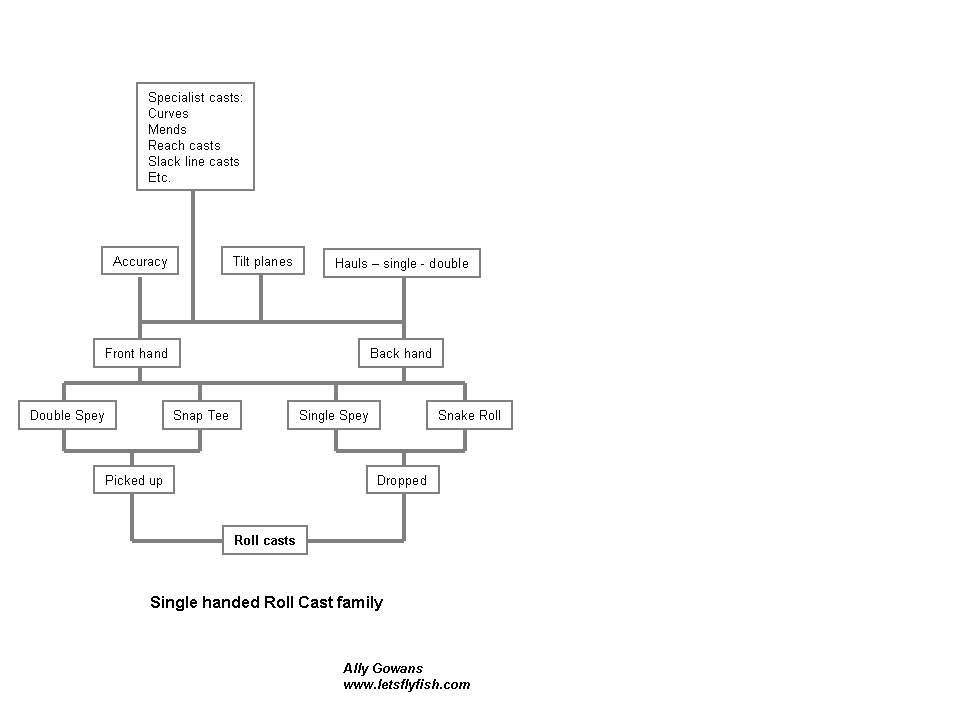
I am attaching a chart
that shows what the Roll cast family for single handed rods may look like but I
am sure that a few of the relatives are missing!
Best
wishes,
Ally
Gowans
Attachment:
roll casting chart.GIF
Description: GIF image