Walter & Group...
Question from Lou Bruno:
Gordy,
I
copied a portion of Bruce’s email, in trying to increase my understanding of the
forces involved, my question is does slide loading or non slide loading affect
the resistance offered by the fly line.
“During the cast, the rod has no idea what the taper is,
only reacts to the resistance offered, and that is from the weight of the fly
line.”
Hi Gordy,
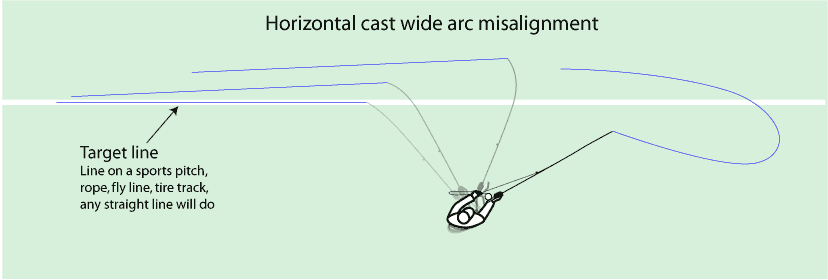
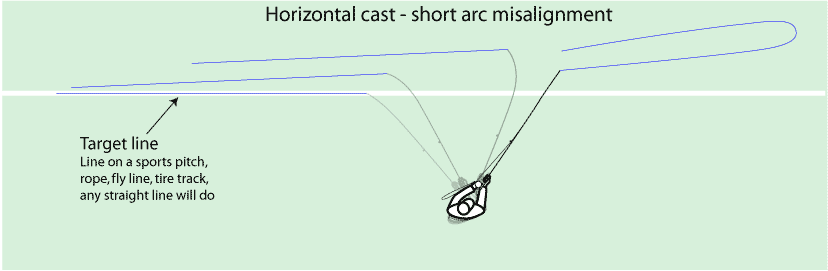
Since you mentioned the cracked wrist wide arc here it is and also a short arc in case these sketches are helpful. All three conditions can are commonly observed as students practice, inevitably there is some over correction.
Best wishes,
Ally Gowans
NOTE ALLY'S ATTACHMENTS.
~~~~~~~~~~~~~~~~~~~~~~~~~~~~~~~~~~~~~~~~~~~~~~~~~~~~~~~~~~~~~~~~~~~~~~~~~~~~~~~~~~~~~~~~~~~~~~~~~`
From Rick Whorwood :
From Tim Rajeff as he answers Rick's question and adds a wealth of information :-
Gordy,
I hope you had a Merry Christmas and plan for an all night dance party for the New Year's Eve.
I am confused by the Subject of your e mail. It refers to Dead Drift but the text refers to swinging a fly. Swinging a fly is a very different situation than dead drifting a fly so I am not sure what to comment on so here goes.
We live in a part of the country where we fish a large range of conditions for steelhead. The need for an easily casting line that can handle level sinking material has led us to come up with the Skagit Compact heads. There has been some research done about how deep a line actually gets while swinging in the current. Tom Keelin tested the resistance of the line to the current (diameter) and compared that to the weight of the line. The study found that the length of a tip has more effect on the depth that the fly achieves than the sink rate of the line. In essence he discovered that a slightly longer length of a lower sink rate is more effective than a short length of faster sink material.
To Dead drift a person will want the most buoyant "float" they can find attached to the densest fly / lure with the least water resistance connected by the thinnest (least water resistant) line. They guys here catch a ton of steelhead using a bobber with lead head jigs. My dirty brother fishes this way and can catch fish where it would be all but impossible to catch a fish with a fly. So if you want to dead drift I suggest using a nymph and indicator. Switch rods were in a large part developed to fish this way. Nymph and Indicator fishing is banned on some rivers like the North Umpqua because it is too effective.
When swinging a fly things have changed over the past 10 years and especially so in the past 3 to 4 years. In years past most people used a multi-tip line with different sink rate tips. They used the fastest sink tip in fast current or deep water. They then used slower sink tips when the water slows down or is shallower. With these lines it might be common to cast across the river at 45 degrees and with a single mend begin fishing soon after the fly hits the water. The average fly used in the days of old was of modest size and weight.
The adoption of the Skagit systems has changed the way people fish. The system was developed to fish ever heavier and water logged flies a9half a rabbit connected to a pound of lead). Not only are the flies heavier but they are designed to fish closer to the bottom than was common 10 years ago. To get a big fly to the bottom of the river requires longer sink tips that are often heavier than the tapered, nice casting, tips of the past. Remember that the original sink tips lines were designed to fish for Atlantic salmon which arguably raise to the fly much more readily than their west coast steelhead cousins and therefore didn't need to "get down". On the Skagit River Ed Ward, Dec Hogan and others developed a system that used Lead Core (LC13) and later Tungsten (T-14) material to make lever tips for their lines. They used heavy sections of level floating and multi staged casts to lift these clumsy tips and big flies out of the water and deliver them to the target.
Skagit heads are often fished at 90 degrees to allow more time for the fly to sink. The results are dramatic when compared to a standard multi-tip line. This larger angle can require several mending moves to "set up" for the swing. Early in the swing the fly will be deeper than multi-tip lines and will "move" fish better than previous methods. The floating portion of the head that connects to the sink tip will often be between 15 to 20 grains / foot making it look and cast like a clothes line. These new thicker heads allow a person to fully load their rods with as little as 20 feet of line. You can cast with very little space behind you with these shorter heads opening up fishing spots previously limited to spin fishermen. Mending line will be accomplished with a tension type of move (common with shooting heads) rather than the line flip move (common with trout line). Longer, thinner, heavier sink tips cut through current variations better than thicker, slower sinking tips.
So if you are planning to smoothly swing a fly at specific water depths using a Skagit head you simply use different lengths of the same sink rate and vary the angle of the cast and number of mends to hit your mark.
(High-lighting of this last key statememt is mine .... G.)
The line drag of a floating line (line sitting on the surface of the water) is not related to diameter in and of itself. The SG (buoyancy) of the line is the major factory in determining the drag of a line (how much of the line is hanging below the surface). A person can effectively fish a head with different amounts of drag by adjusting the tip length and angle of attack to compensate for variations in line drag.
I have found that using a slight heavier fly designed to dive quicker can get down to the fish more effectively than a foot or two of sink tip material.
Sorry if my comments are over simplified and if they don't answer your specific questions.
Happy New Year,
Tim
~~~~~~~~~~~~~~~~~~~~~~~~~~~~~~~~~~~~~~~~~~~~~~~~~~~~~~~~~~~~~~~~~~~~~~~~~~~~~~~~~~~~~~~~~~~~~~~
Tim... Great information. As I think about it, the floating line would have only part of its "body" down in the water, so the resistance would seem to be less. A sinking line of the same diameter, however, would have greater resistance to the water current as its diameter increased.
Attachment:
cracked_wrist.gif
Description: GIF image
Attachment:
short_arc.gif
Description: GIF image