|
Walter & Group...
From Bernd Zeische:
Hello Gordy, hello Jim,
sure "slide loading" exists. It is just a name for a special casting technique. If someone will use this technique sure it exists in his casting. I agree the name may not be well chosen.
I personally would not focus that much on the loading part. Many instructors seem to believe that loading the rod as much as possible will give highest distances. I personally think that the more load we have, the more counterflex will take place and that a) opens up the loop and b) will the effective length of leaver be reduced when increasing rod load.
In regard of slide loading I don't see much of a difference in rod loading in my slomos.
But I see a significant advantage in timing!
Usually all distance casters want to cast far. To cast far we need:
High line speed. High line speed will not be achieve on a small arc! So we need a huge arc. A huge arc then easily results in wide loops. So what we do is rotate the rod as late as possible during the stroke in order to keep the loop front tight.
In other words this means: translation, translation, translation, rotation...
In an average distance technique this means the caster will start with translation mostly when the line is just about unrolled. So gravity will have time to pull in a line sack (into the unrolled line) all the way during translation, translation, translation now.
If instead the caster uses slide loading and starts to translate during unrolling already... he then will start rotation in the moment just before the final unrolling. Now this means there will be less time for gravity to pull in a line sack!
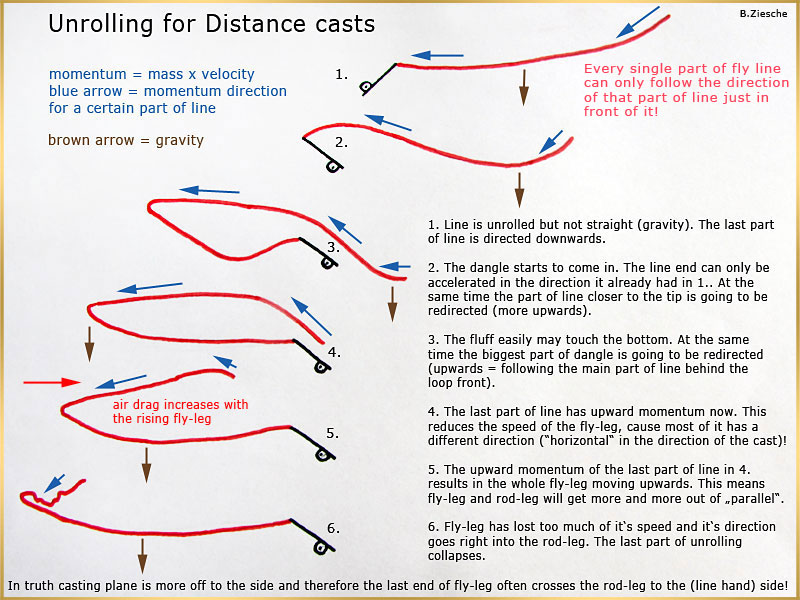
The line sack will result in the "line dangle" during the cast. And the line dangle will result often in the fly-leg "jumping up" and get significant out of "parallel" (was never really parallel anyway) with the rod-leg. Due to that the fly-leg suddenly has a much bigger surface against the air resistance and will be slowed down too much. In the end the unrolling collapses cause the fly-leg is no longer faster than the rod-leg!
This is something that I have observed on many distance casters, not to say all!
Long time I did not have an idea why we all "f.....'d up" the last unrolling on our highest distances. Now I can explain it. We had a huge thread about it on Sexyloops as well. This can be found in the technical forum.
I will attach a link to a picture explaining the whole process more in detail. In true casting we have to take into account that we never cast in one or two dimensions but in 3d... This means the line's end will "jump up and out" since none of us casts 100% vertical that is. The "out" movement will make the fly-leg not only move very fast upwards but outwards and therefore coming back to the line hand side short before last unrolling. Many distance casters will have observed that the fly-leg crosses to the line hand side for the very last part of unrolling and then often collapses - without the help of tailwind or sidewind that is.
Long text much easier to explain on grass or just in person... However I hope the picture might help to understand what am I referring about here.
Best,
Bernd
~~~~~~~~~~~~~~~~~~~~~~~~~~~~~~~~~~~~~~~~~~~~~~~~~~~~~~~~~~~~~~~~~~~
[GH] Bernd,
Those diagrams explain a lot ! For one thing, #3 also explains one of the reasons for "ticking" behind the caster as the forward stroke is made.
You are correct with your comment about "3-d" casts. Simply put, we all use at least slightly different casting planes for the back cast and the forward cast. One exception is the short distance accuracy caster who has become adept at using a strictly vertical rod plane (casting plane) for both.
Gordy
~~~~~~~~~~~~~~~~~~~~~~~~~~~~~~~~~~~~~~~~~~~~~~~~~~~~~~~~~~~~~~~~~~
From Jim Chestnut in answer to Jim Lund's questions on slide loading:
Hi Gordy, Jim and Group,
This article written by George Roberts is a very interesting and
well-written one on "slide loading" and includes a modification that I¡¯ve
not read about before.
That modification is explained toward the end of the article in the
section titled ¡° Putting it all Together¡±. It begins on the 7th line of
that section with the sentence ¡°However, when you begin your forward
stroke, you should continue to shoot running line through the fingers of
your line hand.¡±
I read that paragraph a number of times then grabbed a rod and went
outside to try it. I couldn¡¯t do it, and dismissed it, thinking there had
been some wording mixup. I did not think it was either possible or
desirable.
However, (my own ¡°however¡±), when taking a video while hooked up to some
LED¡¯s to determine the exact release timing I was using when casting
normally, it immediately became perfectly clear that I have been casting
exactly as he described for many years when using my natural style of
slightly sidearm casting.
I also noticed that when using the vertical style, I do the same except
that my backcast sequence goes stop: drift: start translation (forward)
while creeping: re-drift towards the end of translation: clamp the line;
rotate: haul and release.
I know that most people ¨C Paul Arden among them - do not agree with the
notion of ¡°pre-loading¡± the rod. I haven¡¯t formed an opinion on this yet
¨C no longer having a video camera. I doubt the percentages would be with
a caster using that method in a distance casting competition either. Nor
do I think this method would be a good one to try to teach, since it is a
very easy way to develop tailing loops.
I suspect that the reason I slid into this method was my impatience to get
the line onto the water as quickly as possible. That and the fact that
most of my fishing was done at a good distance from the boat ¨C prefering
to get the bite and miss as opposed to spooking them trying to get closer
- or have them disappear on me while trying.
Jim,
"1. I view the slide loading move as "DRAG" during the final back cast
while shooting line. It seems to me that this reduces slack to promote
maximum load when force is applied on the forward cast."
"Drag", if I understand it correctly, basically means literally dragging
the line along with the rod during a translation move. This can't occur
while shooting line in the opposite direction of the translation. So, I
think the only thing reducing slack/sag while shooting into the backcast
is guide and line hand friction and the weight of the line at one's feet
being sucked up into the fly leg.
One thing though when getting Mr. Roberts' technique to work well is that
the backcast has to be a very good tight one and, for want of a better
word, "overpowered".
Cheers,
Jim
~~~~~~~~~~~~~~~~~~~~~~~~~~~~~~~~~~~~~~~~~~~~~~~~~~~~~~~~
[GH] Jim,
One description of CREEP is movement of the rod in the direction of the next cast before the loop has unrolled which decreases available stroke length and casting arc .
We might put forth the thought that when this movement is made leaving sufficient stroke length and arc for the next cast so that there remains a good match between casting arc and rod bend that it is no longer creep and doesn't end with a tailing loop.
Re: "PRE-LOAD". Sometimes I have the sense that I'm feeling it when distance casting. However, this may not actually be occurring. Perhaps some hi-speed video studies have been done which might settle this argument. (??)
Gordy
~~~~~~~~~~~~~~~~~~~~~~~~~~~~~~~~~~~~~~~~~~~~~~~~~~~~~~~~
>From Hank Wu:
Hey Gordy,
I discussed the slide load with Bill Higashi this April in Tokyo and few days ago in Taiwan. I tried to convince Bill the slide load is an efficient way. Yes in Joan's old and new books she talks about the Slide load as a method to preload the rod. And as Paul Arden told me in KL he uses slide load to move his arm to a strongest position and focus on tracking. These two reasons are mentioned in the earlier mail.
But I think their is another reason why slide load is efficient is about the timing. We all know try to remove the slack out off our line is what we are looking for. So we always try very hard to remove all the slack then make the deliver cast. But what is the best timing to start our final deliver cast? Of course is whenever the line is more straight on our back. Then think about this, once we launch the line on our backcast, the line travels backward with some momentum, but meanwhile the line is failing because of the gravity. And once the rearward momentum is gone, actually the line is failing deadly. Some say we should start our last forward cast when the backcast line is totally unrolled. Then we use the stroke to remove the slack and bending the rod. But think about this: how fast we pull the rod without changing the angular of the rod is how fast the line travel. On the other hand, when we finish our last backcast, actually the line travels faster than we just pull because of the leverage!! That means, the launching line on our backcast is faster than the line speed when we pull with our last forward stroke!! And in my opinion, the faster speed has greater ability to fight against the influenced of gravity. If the gravity influences more, we will have more sag in our line, and that is definitely what we don't want.
So with the slide load, we wait the tug feeling, we start to change the angular of the rod on our forward cast just close to the moment the rearward momentum is gone. For me, this means less sag. But without slide load, we wait until the line is totally unrolled backward then we start to pull or move forward, the speed of our line and our hand is equal. So less speed, more sag of line. That is why slide load is efficient for me. But sometimes I will creep when I slide load... Still need practice to master this.
Btw, I did my first MCI test last week examined by Bill Higashi and Soon Lee. Of course I failed because I knew I am not ready yet. But in here I prepared everything along and no way to find a mentor with me. So I need to learn what is the expectation of the test through a real test. And indeed I learned a lot from Bill and Soon. I will be more prepared next time.
Cheers
Hank
�ÄÎÒµÄ iPhone ‚÷ËÍ
~~~~~~~~~~~~~~~~~~~~~~~~~~~~~~~~~~~~~~~~~~~~~~~~~~~~~~~~~~~~~~~~~
To be removed from this mailing list, please click here to unsubscribe
|