|
Walter & Group...
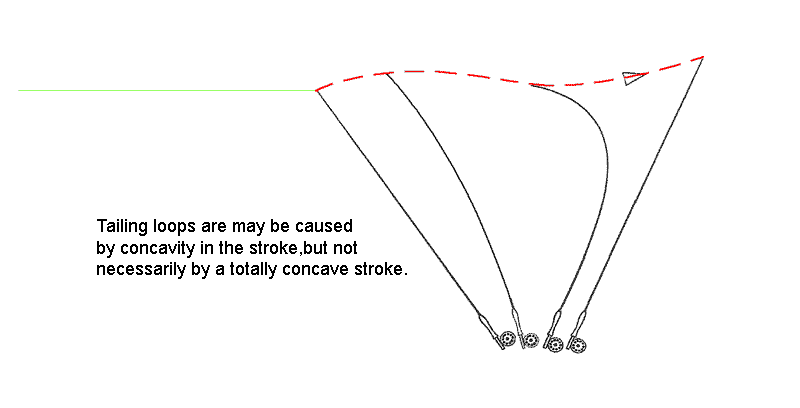
From Ally Gowans. Note his attached sketch:
Hi Gordy,
I produced the rough and quick sketch attached from the one that you sent just to show that we can have convex and concave rod tip motion within a stroke.
Concave – Just think of a “cave” going inwards.
Best regards,
Ally Gowans
~~~~~~~~~~~~~~~~~~~~~~~~~~~~~~~~~~~~~~~~~~~~~~~~~~~~~~~~
From Thomas Berggren:
Hi Gordy ,
My experience in teaching the convex and concave tip path here at my fly fishing school is that most students understand it. Probably because all classes starts on the white board and from there we can agree about the shape of the three tip paths.
But I have made a tool to clarify it outside on the casting range as well. I came up with the idea when I teach curve cast and discovered it was great to use for illustrate many different tip paths.
The tool is a 1'6" Bow (as a bow and arrow) I made from a thin PVC pipe. The string is a thick "laundry line" in a bright color.
The string is the reference for SLP and it's easy to show the student all kind of paths and the string is at the same time the reference of how it should be.
Show it horizontally in position with string up and bow down is concave.
Turn it around with the string down is convex.
And there is more ways to use...
As example when student both have a convex path and a tracking that's curving... Use the "Bow-tool" !!
Show first the "bow up" in horizontal position and then from position in front of the student with the string in line with the casting direction. Keep the bow up and leaning the bow aside vertically to a grade thats equal to the students curving problem and explain the string is SLP and the target line.... It will make sense to the student what the problem is..
The rest is up to us instructors... To make the student move the tip along the "String Line Path"...
I know it can be difficult to bring all kinds of tools out in the field for teaching, but for some of you who might be more stationary on a fishery like me, perhaps it can be useful.
Best regards //
Thomas Berggren,
Lilla Malma Fishery
Malma-Brogetorp
~~~~~~~~~~~~~~~~~~~~~~~~~~~~~~~~~~~~~~~~~~~~~~~~~~~~~~~~~~~~
[GH] Thomas,
Good suggestions for an effective teaching prop.
Cleaver use of the "bow tool" for teaching tracking problems!
Gordy
~~~~~~~~~~~~~~~~~~~~~~~~~~~~~~~~~~~~~~~~~~~~~~~~~~~~~~~~~~~~
From David Edens:
Gordy:
With line tapers, I assume you can also have a regular convex or concave taper.
I would be interested in knowing how the straight taper, regular convex and concave; and compound convex and concave concave tapers differ in casting characteristics.
Let me venture a guess:
Convex taper: Transfers more power to the leader during turnover--Better for bigger flies in windy conditions
Concave taper: The opposite of the above. Less power transfer to the end of the leader, leading to more delicate presentations, better for "spring creek" type conditions
Straight taper: This transfer of power would probably be in between the convex and compound tapers. A more "all round" fly line.
Compound taper: I believe this would lessen the effects of the convex or compound taper, leading to power transfer between the regular convex or compound taper and the straight taper.
Are these differences in fly line performance noticeable? to advanced casters? Probably. To novices? Probably not.
I would be interested in seeing other opinions on this subject.
David
~~~~~~~~~~~~~~~~~~~~~~~~~~~~~~~~~~~~~~~~~~~~~~~~~~~~~~~
[GH] David,
Basically, you are correct, as I see it, except for your statements :-
"With line tapers, I assume you can have a regular convex or concave taper"
and:
"Compound taper: I believe this would lessen the effects of the convex or compound taper leading to power transfer between the regular convex or compound taper and the straight taper."
As I understand it, tapers are either straight (the line tapers steadily from one end of the forward taper to the other) or compound. Compound tapers can be either convex compound or concave compound according to the classification offered by Bruce Richards in his Modern Fly Lines.
Putting it another way, I see all convex and concave forward tapers by their very geometry to be "compound". No such thing as a "straight convex" or "straight concave".
Too bad this little book is so hard to find. Bruce's detailed description of the way these different tapers perform can't be improved upon. If you can possibly "beg, borrow, or steal" a copy you'll be glad you did.
To your last question, the answer is YES. For most compound forward tapers there is a big difference in performance because of the effect these tapers have on the rate of dissipation of energy as the line loop unrolls. Examples:
1. I'd have a hard time turning over a big bass bug cast into a breeze if I used a compound concave taper, but it would be a lot easier if I used a compound convex taper. Why? Because the concave taper would lead to more gradual dissipation of energy, so the cast might well collapse. The convex taper, would turn over the line loop much more forcibly and carry the bug to its destination.
2. If I used a compound convex taper to deliver my dry fly I'd probably have a splash down rather than a delicate presentation. All else being unchanged, I could realize my soft presentation if I switched to a line with a compound concave taper.
One exception is the very slight convexity of the profile of the Triangle taper where the convex compound change from straight taper is so gradual that I'm not sure it would make a great deal of difference to the non-expert caster.
It stands to reason that not all these tapers from multiple manufacturers will have the same degree of convexity or concavity, so the performances of these lines will likely differ. As far as I know, this is not a standardized feature.
Having said all this, whether straight, compound convex, or compound concave, a major factor in the aggressiveness of loop turnover and therefore presentation is the overall profile of the forward taper itself. In general, steep, short tapers turn over more quickly and allow the use of larger flies, while gradual longer tapers are best for soft, delicate presentations.
Gordy
~~~~~~~~~~~~~~~~~~~~~~~~~~~~~~~~~~~~~~~~~~~~~~~~~~~~~~~~
To be removed from this mailing list, please click here to unsubscribe
|
Attachment:
convex-concave compound path.png
Description: PNG image