|
Walter&Group...
~~~~~~~~~~~~~~~~~~~~~~~~~~~~~~~~~~~~~~~~~~~~~~~~~~~~~~~~~~~~~~~~~~~~
>From Gary Davison:
Gordy,
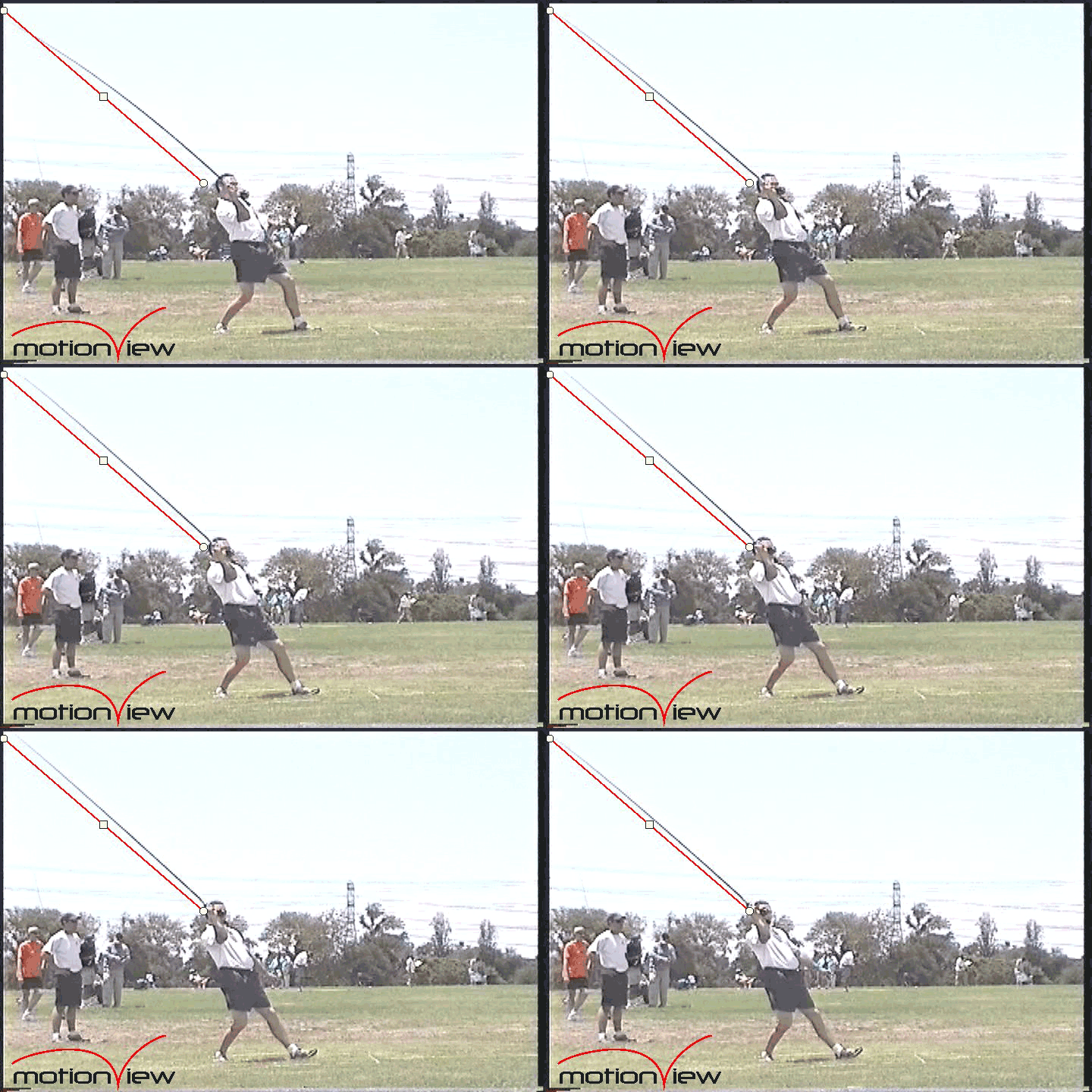
I would call Bernd Ziesche cast an underslung loop not a tailing loop.
However would you call the wave in the line just left of the tree in the middle of the picture a tendency to tail?
This is based on your attached picture provided?
Just an observation.
Gary
~~~~~~~~~~~~~~~~~~~~~~~~~~~~~~~~~~~~~~~~~~~~~~~~~~~~~~~~~~~~~~~~~~
Gary,
It is based on the picture Bernd provided and I sent.
I agree, it is not a tailing loop. I do use the term, "underslung loop"
That tiny bend in the fly leg is so small, I'd hesitate to classify it. I would probably have missed it while watching the live cast.
Gordy
~~~~~~~~~~~~~~~~~~~~~~~~~~~~~~~~~~~~~~~~~~~~~~~~~~~~~~~~~~~~~~~~~
>From Guy Manning:
I no longer mark someone down for a tailing tendency and feel it is wrong to do so. When Joe Libeu was traveling around and having MCI and BOG cast, in order to discover what was reasonable to expect from MCI candidates, it was clear that all 6 of us had tailing tendencies in that day. Even Al Kyte, and he was the one who told me it was considered a fault.
I started looking at it a bit harder and trying to come up with other causes, poor leader construction had been mentioned, as well as too bulky a fly. Experience told me those were the wrong avenues.
Then I was watching the video from which I extracted the gif above. I can see at least 3 or 4 cycles (oscillations) of the rod tip after the stop has been made, due to its efficiency. Each of these rebounds is going to create a small wave in the line. Since it takes time for the wave to propagate the length of the line, it is possible the leader is being pulled through one of those waves as it is pulled forward. That could lead to what we call tailing tendencies, something many view as a fault. Consider that a hard stop and heavily loaded rod will often transfer excessive energy to the fly creating a kick, this in turn creates a wave propagating back up the line**. When the wave from the fly meets the wave from the tip they appear to have an additive effect creating a larger wave**. What if the leader is being pulled through that at the time we perceive the tailing tendency?
If my example is true, the problem is not a fault in the cast or caster. If anything it is caused by something we all want, a lot of load and a hard stop. I have no video with enough detail that also shows the entire line, for me to provide a better example, but until another theory proves me wrong, that is what I believe is happening.
The above address is to a wave on a string simulator.
Use settings: Manual, tension 20, damping 20, loose end.
Make a single sine wave (up, down, and back to center). When the wave gets about 75% of the way down, make another complete sine wave. Watch what happens when the 2nd wave hits the reflected wave.
None of this is scientific proof but it makes you think.
Guy Manning
~~~~~~~~~~~~~~~~~~~~~~~~~~~~~~~~~~~~~~~~~~~~~~~~~~~~~~~~~~~~~~~~~~~~
[GH] Guy,
Yes. I'm aware of the tendency to tail with many of my own casts. Especially with various leader designs as well as when casting heavy or bulky flies. I'm also aware of the appearance of tendency to tail when the six of you were appropriately critical of your own casts. More of us should carefully critique our own casts.
It is less likely to occur with short and medium distance casts or purposely done loop demonstrations as performed during certification or MCI testing because the candidate is expected to use tackle including short well designed leaders (8' or so) and very light, hookless yarn or similar flies. Even so, weather conditions including wind can help introduce those small aberrations.
For that reason, I'd certainly not flunk the very slight or even occasional moderate dip in the fly leg.
Examiners should also be wary of flunking even repeated tendencies to tail when the test is given during inclement weather if we are to be fair to the candidate, as I see it.
Putting it another way: If I use tackle similar to the outfit the candidate is using and cast during the same weather conditions and I make a few "almost tails", I cannot flunk him for doing the same.
These kinds of discussions become very important as we try to become better examiners. Even more so as we enter a phase of specifically training and vetting new Masters to become competent, fair examiners.
Going back to the four examples in my last message:
1.) I would flunk. It is certainly not a decent cast to demonstrate good loop control for students.
2.) This one deserves a flunk, I think, because of the obvious creep as well as the pronounced tendency to tail.
3.) The very slight defect in the fly leg of the loop, by itself, is not one I'd flunk.
4.) Bernd's cast doesn't form a tail. It is the effect of gravity on the line during a distance cast. I'd pass it.
Gordy
~~~~~~~~~~~~~~~~~~~~~~~~~~~~~~~~~~~~~~~~~~~~~~~~~~~~~~~~~~~~~~~~~~~~~
To be removed from this mailing list, please click here to unsubscribe
|