Walter & Group...
From Guy Manning :
Gordy,
I love this thread. J
Now to screw it all up. If you look at Aitor’s video labeled Late Tail - http://vimeo.com/16390212
Note that the caster is casting upright and that the camera is shooting perpendicular to the plane of the cast. Therefore we can’t blame the following on a tilted casting plane.
Challenge: Show me where the line crosses itself during the cast.
This cast does not exhibit a tail according to any definition I am aware of. Pretty much every definition of a tail talks about the lines crossing. Well this one doesn’t, therefore it isn’t a tail? J
Guy Manning
~~~~~~~~~~~~~~~~~~~~~~~~~~~~~~~~~~~~~~~~~~~~~~~~~~~~~~~~~~~~~~~~~~~~~~~~~~~~~~~~~~~~~
[GH] Guy,
It does not actually cross over. The wave in the line, however, is crystal clear as is the "almost tail" ("Tendency to tail").
Looks to me that this is a "tendency to tail" and that in the event the caster didn't dip the rod tip down as far as it appears at the end of the cast, the same sequence would have appeared..... but with a definite loop leg crossover.
Gordy
~~~~~~~~~~~~~~~~~~~~~~~~~~~~~~~~~~~~~~~~~~~~~~~~~~~~~~~~~~~~~~~~~~~~~~~~~~~~~~~~~~~~~~
[GH] Troy Miller qualifies his last note :
Hi Gordy –
Oops, I should’ve written that that last one was between you and me. It was a reply to your request about the physics of snap casts (the part about Server’s bounceback suggestion). With two topics going at the same time, I should’ve clarified what I was talking about on each part. I challenged your question (how does a snap cast work?) with a question of my own (what makes flyline move?). I don’t know if you still wanted to work on that topic or not.
Unfortunately, while at work I can’t open any videos. They prohibit/filter any streaming media from coming through our firewall. It’s a real bummer since I don’t get to look at what y’all are looking at. I can only read what others have to say, but not make my own analysis.
Not exactly clear who said this, but I disagree with this statement:
"Just as with the arial mends, if we make the move right at loop formation the mend travels all the way out, if we make the tail right at the beginning of the stroke, it has to travel all the way out before it can manifest itself truly."
The reason is that mends are manipulation of the bottom leg of the loop, while tails are a flaw in how the top leg unrolls in relation to the lower leg. Of course, mends occur in response to actions after loop formation, while tails are a product of specific movements prior to loop formation. There is no reason to expect them to behave in similar fashion…
I understand Feynman’s quote, but I like Einstein’s better:
“If the facts don't fit the theory, change the facts.”
Tongue in cheek, of course… J
I don’t condemn conjecture, since it eventually leads us to plausible theories. Just so the conjecture was preceded by considerable focused and astute observation. Some folks have an eye for fine details, while others don’t. Curiosity, observation, unbridled/unbiased thinking – these provide the initiative to expand one’s capacity for deeper understanding.
One final quote, paraphrased from something also attributed to Feynman:
“I try to have an open mind. Just not so open that all my brains fall out…”
Congrats on your striper trip in NY (was it Montauk?). Looks like you had an absolute BLAST! I need to go play on that playground someday…
Regards,
Troy Miller
~~~~~~~~~~~~~~~~~~~~~~~~~~~~~~~~~~~~~~~~~~~~~~~~~~~~~~~~~~~~~~~~~~~~~~~~~~
Troy Miller
~~~~~~~~~~~~~~~~~~~~~~~~~~~~~~~~~~~~~~~~~~~~~~~~~~~~~~~~~~~~~~~~~~~~~~~~~~
[GH] Too bad you can't access the video's ! A lot to be learned from them. If you have a private email address and computer, I'll forward them to you.
We'll attack the SNAP CAST at a later time.
The striper trip started at Nantucket, then to Long Island including Peconic Bay and Montauk. Most of the fish had already migrated S. from Nantucket. They were in unbelievable numbers at Montauk.
Gordy
~~~~~~~~~~~~~~~~~~~~~~~~~~~~~~~~~~~~~~~~~~~~~~~~~~~~~~~~~~~~~~~~~~~~~~~~~~~~~
From Aitor Coteron. See how many of you can answer his question(Editing and highlighting mine) :
Hi Gordy,
After exchanging some private messages with Mac I have corroborated that there is a misunderstanding in the terms "early" and "late" when applied to a tailing loop. Each of us have a different idea of what that exactly means.
However it seems crystal clear what those same "early" an "late" are when applied to the place in the casting stroke where the fault producing the tailing loop is located.
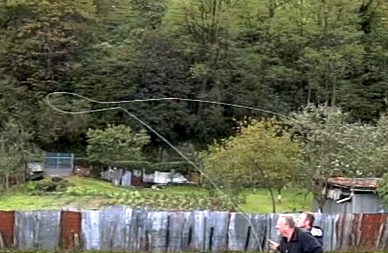
So, why not pose the problem the other way round? On this pic we can see the hint of a tailing loop.
Where in the stroke is the fault that caused it placed? Early in the stroke or late in the stroke?
~~~~~~~~~~~~~~~~~~~~~~~~~~~~~~~~~~~~~~~~~~~~~~~~~~~~~~~~~~~~~~~~~~~~~~~~~~~~~~~~~~~~~~
~~~~~~~~~~~~~~~~~~~~~~~~~~~~~~~~~~~~~~~~~~~~~~~~~~~~~~~~~~~~~~~~~~~~~~~~~~~~~~~~~~~~~~
[GH] From Guy Manning re Aitor's video clips sent yesterday :
Gordy,
We have no disagreement as to whether it is a tail or not. This tailed badly. But it calls in to question the definitions. Lasse brings up that we might want to use the tip path and not the line as the points of cross over.
Guy Manning
~~~~~~~~~~~~~~~~~~~~~~~~~~~~~~~~~~~~~~~~~~~~~~~~~~~~~~~~~~~~~~~~~~~~~~~~~~~~~~~~~~~~~
[GH] Guy...
Lasse has a point, there.
That would make the definition of a tailing loop include what we've been calling an "almost tail" or a "tendency to tail".
As we administer our MCI exams, I think most of us would flunk a distance cast made with this... even though no full line crossover occurred and no tangle.
It would also raise the question as to whether we should pass on this as a tailing loop when CCI and MCI candidates are asked to demonstrate them.
Gordy