|
Gordy,
all interesting, in response to Zigi's comments, as well as Al Buhr's writings, on a rod's action and speed, can anyone give examples (manufacturer + model) of a tip action rod that is slow, or a fast rod that bends deep?
craig
Take your time in answering these questions.
~~~~~~~~~~~~~~~~~~~~~~~~~~~~~~~~~~~~~~~~~~~~~~~~~~~~~~~~~~~~~~~~~~~~~~~
From Len Zickler. Most of his answers are "crisp" :
1.) We've read several interpretations and descriptions of these words applied to fly rods in our past messages.
Question: Which of these (or your own) descriptions make the most sense to YOU.
a. Fly rod action.
b. Fly rod strength.
c. Fly rod speed.
Len’s ANSWER: Fly rod action or how much a particular rod bends and where.
2.) Your student is a 15 year old high school student who is taking a fly casting course as an elective to help complete his physical education requirements. He has a low grade average.
He asks you this question after raising his hand in class :
"We read about 'effective rod lengths', but I still don't understand what this means. Could you explain it in simple terms ? "
Question: How do you answer him ?
Len: The implication in the question “set up” suggests the student may be a little slow – so a very simple answer is called for, which should be our goal in any case. The question he asks suggests otherwise (some people are disguised as losers – don’t let appearances fool you!).
ANSWER: Faster action rods tend to bend less – therefore a 9 foot “fast” action rod perhaps has an effective length of 8 feet. A slower action rod would tend to bend more – therefore the effective rod length would be less, perhaps 6 feet. I would visually demonstrate the concept using one rod.
3.) After you answered the student in 2.), he then asks :
"Well..... how will this help me when I go to buy a fly rod to catch striped bass ?"
Question: What do you tell him ?
Len: this will help you buy the right rod for striped bass. I would recommend a heavier 9 foot, 7 to 9 weight rod (depending on where you intend to fish) , with a medium action.
4.) How would you explain each of these terms to your student at an intermediate level :
a. Fly rod action. L: How much the rod bends
b. Fly rod strength. L: The size of fish you can catch before the rod breaks.
c. Fly rod speed. L: How quickly the rod returns to a straightened position after it is bent in the cast.
d. Overall length. Length measured from tip to handle butt.
e. Rod rating. (Line wt. rating.) L: The rod weight conforming to the weight of fly line cast. 6 wt line – 6 wt rod – a matched system.
Try to use these five terms as you answer questions 4 - 8, below :-
5.) Use these five terms to explain to your early casting student what rod he should purchase for his fly casting lessons. He is 20 years old, medium height and slender. Calm temperament. He wants to learn how to fly fish so he can fish brook trout in local streams.
Len: I would recommend a slow or medium action 8 1/2 foot, 4 or 5 weight rod.
6.) Use these terms to describe the fly rod you would recommend for Nancy who is a 34 year old accomplished caster. She is short (5') - (150 cm.) and weighs 110 lbs. (50Kg.) . She is a dance instructor. She wants to use it to catch panfish in the lake.
Len: A 8 ½ to 9 foot medium to fast action, 3 to 5 weight rod.
7.) Jack is a big fellow. He is a professional football player who plays many other sports very well. He's also a scratch golfer. He wants to take his first trip to the Florida Keys to catch a big tarpon. He has caught lots of trout and large salmon, but has never before fished in the salt.
Question : What rod do you recommend ?
Len: A very strong, 9 foot, fast action, 11 or 12 weight rod.
8.) You are about to order 15 fly rods for your fly fishing school as school rods. The courses you usually teach are at the beginner - intermediate level. Your students may be of any age and physical description.
Question : What rods do you order ?
Len: A set of 5 or 6 weight, 9 foot, medium action rods.
9.) Now you have offered to give a course on advanced fly casting. One of the students who has signed up for the course calls you for your recommendation on what fly rod he should bring.
Question: What questions would you ask of him before giving advice ?
L: Are you having particular problems you want addressed? What kind of fishing do you do? Bring the rod you fish most often.
10.) Your long term student calls you for advice. He is a vigorous 40 year old ski instructor of average height and build . Ski season is over and he's been invited to fish a river in Africa for a fish you know nothing about. He wants to know the best fly rod for this venture.
Question: What questions would you ask of him before coming up with a recommendation ?
L: I agree with the answer given – do a little research on-line, contact local guides - you may be fishing for a variety of species. Perhaps take multiple rods for the species identified. Not a bad idea to have back-ups.
10. NOW FOR THE QUINELLA !
This question is from Craig Buckbee. Highlighting is mine :
Gordy,
all interesting, in response to Zigi's comments, as well as Al Buhr's writings, on a rod's action and speed, can anyone give examples (manufacturer + model) of a tip action rod that is slow, or a fast rod that bends deep?
L: Not to my knowledge.
~~~~~~~~~~~~~~~~~~~~~~~~~~~~~~~~~~~~~~~~~~~~~~~~~~~~~~~~~~~~~~~~~~~~~~
[GH] One last set of answers. This from Jim Chestnut. Take note of yet another style of answering questions and a personal point of view regarding fly rod parameters . No "canned" or "cookie cutter" answers. A couple of pictures to illustrate his points. :
Hi Gordy,
I'm sending this in HTML because I think that's how you are sending them. They are much easier to read that way. If that does not work for you, I can change back to the text way.
1.) We've read several interpretations and descriptions of these words
applied to fly rods in our past messages.
Question: Which of these (or your own) descriptions make the most sense
to YOU.
a. Fly rod action.
b. Fly rod strength.
c. Fly rod speed.
To me, all three and even more would help. The terms fast, medium and slow seem to be interchangeable with rod action and rod speed both, even though that may not be the case. I think the terms tip flex, progressive flex, mid flex and deep bending would better describe the action than fast, medium and slow.
The rod “speed” I believe should indicate the recovery rate from flexing which could be based on oscillation frequency or some other easily measureable method. Simply using the modulous of elasticity for the material would not work because the taper, wall thickness and weight of guides and ferrules greatly affects the frequency.
Rod strength is another vague term because a thin walled but large diameter blank could easily carry a high estimated line wt. rating, yet snap like a pretzel with a tarpon on for instance. Fortunately, the rod manufacturers want their rods to hold up to the loads they expect them to be subjected to, and manufacture them sensibly. I think it is better to stick simply to rod “weight” ratings, and further elaborate on “fish fighting” characteristics and so on as a separate issue.
2.) Your student is a 15 year old high school student who is taking a fly casting course as an elective to help complete his physical education requirements. He has a low grade average.
He asks you this question after raising his hand in class :
"We read about 'effective rod lengths', but I still don't understand what this means. Could you explain it in simple terms ? "
Question: How do you answer him ?
OK, let’s say you hold your rod , reel and line in your hand by the handle straight up and down next to a building. We duct tape a tape measure onto the building starting right where the top of the rod is and let it hang down. Now, you stand next to the tape measure and cast the rod with 40 feet of line out while we take a video. We look at the video and see where the fly line crosses the tape measure. If it crosses at say 2 feet below the start of the tape measure, and your rod is 9 feet long, then your rod has an effective rod length of 9 feet minus 2 feet (or 7 feet) when you are casting 40 feet of this line.
3.) After you answered the student in 2.), he then asks :
"Well..... how will this help me when I go to buy a fly rod to catch striped bass ?"
Question: What do you tell him ?
If you are wading at the beach for them, you want a rod with a pretty long effective rod length to help keep the line higher above the water, since your elbow will be closer to it than if you were standing on a dock or in a boat. Rods with a long effective rod length usually are easier to throw a tight loop into the wind with as well.
But remember than the longer the effective rod length is, the harder it is to move it fast from a stop – to accellerate it. Think how easy it is to swing a badminton racquet, but tape it onto a broom stick and see how much harder it is. Same reason why you don’t use a whole broomstick when playing stickball, you always cut some off so you can swing it faster.
4.) How would you explain each of these terms to your student at an intermediate level :
a. Fly rod action. Tip action, “progressive” action, mid flex, deep flex. All refer to where and how the rod bends.
b. Fly rod strength. This (to me) refers to lifting strength and resistance to breakage. The price paid is generally more weight and deeper flex. Old ones like I use in a 12 and 9wt (Sage RPLX’s, are stiff and referred to as broomsticks by many younger fly fishers.
c. Fly rod speed. Rod “speed” refers to how fast the rod recovers from bending.
d. Overall length. The total length of the rod from butt to tip top.
e. Rod rating. (Line wt. rating.) The rod rating refers to the line weight which the manufacturer assumes will work well for the average caster aerializing 30 feet of line out of the rod tip.
5.) Use these five terms to explain to your early casting student what rod he should purchase for his fly casting lessons. He is 20 years old, medium height and slender. Calm temperament. He wants to learn how to fly fish so he can fish brook trout in local streams.
I would say you would want a 5 weight – probably a light, mid flex (medium action) rod of 7 ½ to 8 feet overall length for small streams. This will give you enough weight to fish nymphs yet not too long and cumbersome for tromping through the puckerbrush to get to the good spots. Such rods are good for delicate presentations, and you could always drop down a line size for very delicate presentations. They are also good for protecting light tippets should you hook an unexpectedly large one.
6.) Use these terms to describe the fly rod you would recommend for Nancy who is a 34 year old accomplished caster. She is short (5') - (150 cm.) and weighs 110 lbs. (50Kg.) . She is a dance instructor. She wants to use it to catch panfish in the lake.
I would recommend a fast, high modulous 9’ 6wt rod with a tip flex. Lakes are prone to windy conditions and your casts will likely average longer than on small streams. Such a rod will be good for throwing very tight loops into the wind, and keeping the line away from you during those conditions. It will also be enough rod for bass and for throwing moderate sized poppers and spun deer hair flies.
7.) Jack is a big fellow. He is a professional football player who plays many other sports very well. He's also a scratch golfer. He wants to take his first trip to the Florida Keys to catch a big tarpon. He has caught lots of trout and large salmon, but has never before fished in the salt.
Question : What rod do you recommend ?
I would recommend a 12 wt. of 9’. Frankly, I haven’t even tried any new 12 wts as I am still happy with my old Sage RPLX which has caught a bunch of tarpon and thrown a lot of flies. I would describe it as stiff, heavy, mid-flex, medium-fast recovery. I would leave foregrip or no foregrip up to him, but I wouldn’t use one without myself being only 155 lbs. I really don’t expect that there is a whole lot of difference between rods once you get into that size range. I know many guys really like the Sage xi3’s, Loomis Crosscurrents and Helilos. I haven't tried any of them.
Note: For Nancy and Jack, I would advise them to go to their local dealer and cast several rods, since they are already experienced, to see which suits their casting style best.
9.) Now you have offered to give a course on advanced fly casting. One of the students who has signed up for the course calls you for your recommendation on what fly rod he should bring.
Question: What questions would you ask of him before giving advice ?
What do you want to get out of the course? Are there any particular things you want to work on, are having trouble with or don't know but want to learn? What kind of fishing do you do? What species? What sizes? What casting range are you comfortable in? Do you have any shoulder, elbow or wrist problems. What kind of shape is your casting arm in?
10. NOW FOR THE QUINELLA !
This question is from Craig Buckbee. Highlighting is mine :Gordy,
all interesting, in response to Zigi's comments, as well as Al Buhr's writings, on a rod's action and speed, can anyone give examples (manufacturer + model) of a tip action rod that is slow, or a fast rod that bends deep?
Craig
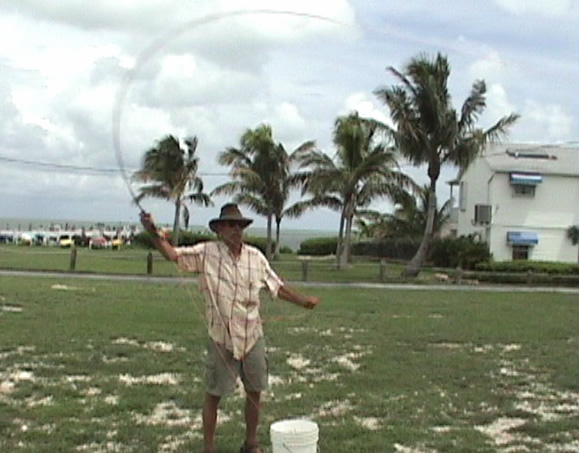
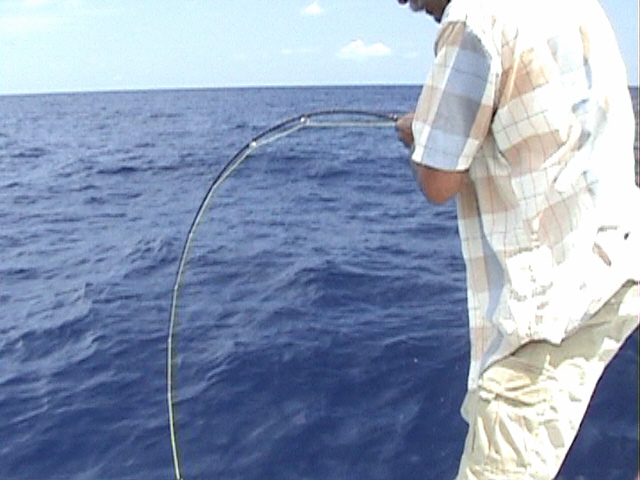
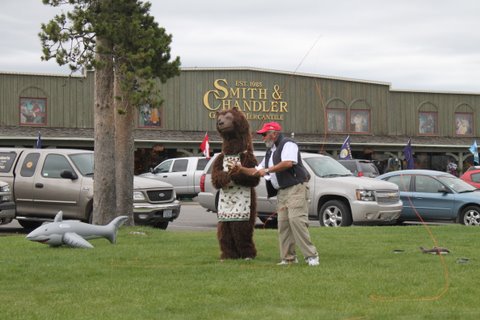
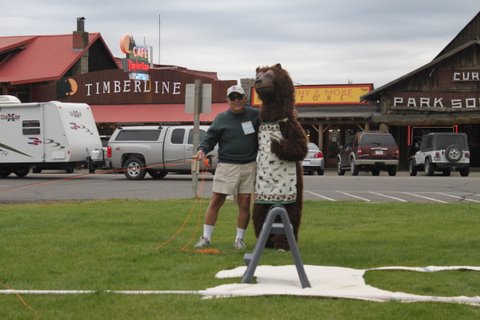
That is a tough question because I’m not sure how deep, deep is. I would say that the Sage 5wt and 8wt TCR’s bend pretty deep (without breaking), but I don’t know if someone else would consider them bending deep or not. Below is a picture of a backcast at close to maximum rod bend grabbed off a video of a TCR 8 wt lined with a 7 wt SA MED. According to the Sexyloops rod database it has an action angle of 73 and an estimated rod number of 10.7 using the CCS system. I’m guessing I had maybe 60’ of line out when this shot was taken. The one below is the same rod with a fish on that I sent you before, Gordy following a discussion about effective rod length as it pertains to lifting fish.
Cheers,
Jim
|