[Date Prev][Date Next][Thread Prev][Thread Next]
Thread Index
Date Index
Subject Index
Leaders / Acceleratlion vs. rod tip path
- Subject: Leaders / Acceleratlion vs. rod tip path
- Date: Tue, 11 May 2010 14:16:19 -0400
Walter & Group...
From Ally Gowans :
Hi
Gordy,
I forgot to say
something else about leaders and flies. Heavy flies have usually possess more
energy than the leader can transmit at the extremity of the cast so there are
times when the leader turns over the fly and times when the fly straightens out
the leader. The heavy brass tubes that we use in salmon fishing fall into that
category and without doubt a stiff fluorocarbon leader results in less problems
whilst employing these flies.
Best
regards,
Ally
Gowans
~~~~~~~~~~~~~~~~~~~~~~~~~~~~~~~~~~~~~~~~~~~~~~~~~~~~~~~~~~~~~~~~~~~~~~~~~~~~~~~~~~~~~~~~``
Ally... That fits with what I've found with
heavy salt water flies. Lots of kinetic energy in those moving
flies.
In that case, however, the relatively "soft" 60 lb.
test nylon mono. butt sections comprising more than 50% of the leader length are
still "stiffer" than the end of the fly line and so perform in a manner similar
to proprietory stiff nylon mono. of lesser diameter/bulk.
These heavy salt water leaders are usually
fitted to fly lines in the WF10 to WF12 range. They have sufficient mass
distribution to achieve sufficiently high energy flow to turn over tarpon
leaders with large flies despite the lack of what most would consider a sensible
taper. (60# butt section = 6' - 7', "Tapered section" = 1 1/2' - 3' of
40#, Tippet = 2' - 3' of 15# or 20#, Shock (bite) tippet = 12" 40# to 80#
Fluorocarbon ).
Sometimes I fish with a leader which has no real
taper.... goes from about 6' of 60# nylon mono. to a loop-to-loop connection
with 3' of 15# mono. class tippet and then 1' of 60# fluorocarbon shock
tippet. They still turn over well.
Of course it becomes immediately apparent that there is
lots of energy left to effect the final turnover of the big SW fly because of
incomplete dissipation of energy as the whole thing unfurls. Soft entry
being a less important goal.
When fishing on very slick calm days when the same tarpon
are skittish, that system won't work. For that circumstance I use smaller
and much lighter flies and a more tapered leader formula. Even then,
though, I'll not drop below 50# nylon mono for my butt section. My shock
tippet goes way down to 30# Fluorocarbon. This despite the greater
likelihood that a large fish will rasp through it if fought long
enough.
Gordy
~~~~~~~~~~~~~~~~~~~~~~~~~~~~~~~~~~~~~~~~~~~~~~~~~~~~~~~~~~~~~~~~~~~~~~~~~~~~~~~~~~~~~~~~
ACCELERATION / ROD TIP PATH (Followup)
~~~~~~~~~~~~~~~~~~~~~~~~~~~~~~~~~~~~~~~~~~~~~~~~~~~~~~~~~~~~~~~~~~~~~~~~~~~~~~~~~~~~~~~~~
Message answering my comment on yesterday's
message on acceleration / rod tip path from Walter Simberski
:-
"In # 4.
..... When the rod tip is at the mid point of the
casting arc it has to be significantly behind the mid point travel of the butt
section of the rod because of rod bend. So at that point the casting
arc may well be almost complete."
Hi Gordy,
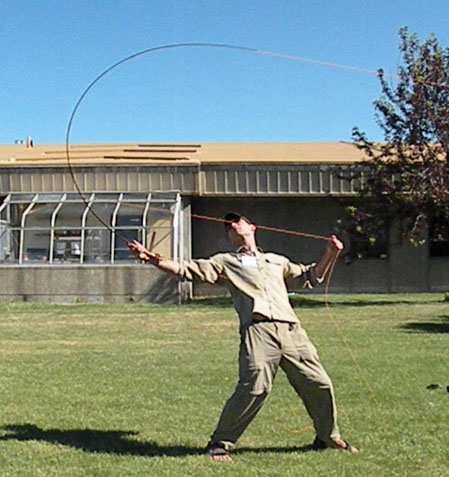
With respect to the rod tip at the mid point of the
casting arc you make a good point. Here is a very
good example.
Basically, if the rod did not bend it would trace
an arc (i.e. a section of a circle) but since we want to
follow an slp the rod tip will trace the chord for
that particular arc. This means the effective rod length
must be decreasing to the point where the rod tip
passes the mid point of the chord. From there on
the erl must be increasing to stay on the chord. In
order for the erl to increase we need to reduce the
amount of force we are applying to the rod
butt...
Thanks
Walter
~~~~~~~~~~~~~~~~~~~~~~~~~~~~~~~~~~~~~~~~~~~~~~~~~~~~~~~~~~~~~~~~~~~~~~~~~~~~~~~~~~~~~~~~~~~~~~~~~
Walter... I placed your picture
in an attachment. GREAT EXAMPLE !!!!!
Looks to me like Chase Jablonski making one
of his incredible back casts. His grip isn't easy to see at this
range, but it reminded me of his distinct change of grip between the back cast
and the forward cast which he uses for his long distance competitive
casts. ( Very loose grip during "hang time". Tight
in proportion to rod load. )
Gordy
~~~~~~~~~~~~~~~~~~~~~~~~~~~~~~~~~~~~~~~~~~~~~~~~~~~~~~~~~~~~~~~~~~~~~~~~~~~~~~~~~~~~~~~~~~~~~~~~~~~
Walter clarifies his statements on acceleration
curves :
Hi Gordy,
It appears that I haven't made myself clear in my
observations on acceleration. I do not advocate a non-constant
acceleration. I thought I was making it clear that
constant acceleration was not only desireable but necessary for
a number of reasons. However, we also need to look
at the boundary conditions, i.e. does the rod behave differently
at the beginning or the end of the casting stroke.
I haven't seen anything that we would not expect at the end of the
stroke but the idea
that the rod can "kick back" at the start of the cast and the affect this can
have on the cast is
very well described by Don Phillips in his book, "The Technology of Fly Rods", on page
87.
Phillips tells us that the amount of what I call kick back is
dependent on the amount of force that is applied at the
beginning of the casting stroke. I believe that the action of the
rod is also a contributing factor. Obviously a human is not
able to make a broom stick kick back because a normal human is unable to
even make a broomstick bend noticeably
with a casting stroke. On the other hand, a very noodly rod will be
prone to kick back and the more noodly the rod the
greater the kick back. Also a rod that is full flex in nature is going to
have a more pronounced kick back then a tip flex
rod. I find it fairly easy to make my 6 wt, 9 ft, TCX kick back a foot or
more. I can only surmise that a lighter rod with
a slower action can kick back 2 feet or more with little effort.
Does this phenomenon actually happen during real life casting? I have seen one case where this phenomenon
was captured on film. It
required the use of high definition, high speed still photography
to capture the kick back.
The cast was also captured on video simultaneously and I reviewed the video
a number of times without being
able to spot the kick back that was obvious in the still photo.
So to make my view clear - I think that for the majority of the casting
stroke constant force/acceleration is the most
efficient means to make a casting stroke. I think a smooth transition from
zero force to the constant force used in the
majority of the casting stroke is a good thing as it ensures that we don't
experience kick back irregardless of the rod
characteristics or distance being cast. This transition phase in my opinion
is on the order of 1 or 2 degrees, i.e. until
we have the rod tip moving in the direction of the casting stroke for most
casts. Even when casting with a very noodly,
full flex rod for maximum distance I doubt if the transition phase is ever
more than a few degrees of rotation. This initial
start up phase is a very small percentage of the casting stroke. If we
sustain this start up/transition phase for more
than a few degrees of rotation we end up with waves in the fly line and
this will result in tailing loops after the loop
forms.
Thanks
Walter
~~~~~~~~~~~~~~~~~~~~~~~~~~~~~~~~~~~~~~~~~~~~~~~~~~~~~~~~~~~~~~~~~~~~~~~~~~~~~~~~~~~~~~~~~~~~~~~~
Walter.... You knew full well you would
light a fire with your analysis. You rattled Bruce's
chain.
Putting "fire in our bellies" helps us
learn !
Well
done. Gordy
~~~~~~~~~~~~~~~~~~~~~~~~~~~~~~~~~~~~~~~~~~~~~~~~~~~~~~~~~~~~~~~~~~~~~~~~~~~~~~~~~~~~~~~~
From Aitor Coteron :
Hi Gordy,
Another intersting issue is that in absence of amosphere a lead ball, an
elephant and a feather, when dropped from the same height, all three reach the
ground at precisely the same time.
Regards,
Aitor
~~~~~~~~~~~~~~~~~~~~~~~~~~~~~~~~~~~~~~~~~~~~~~~~~~~~~~~~~~~~~~~~~~~~~~~~~~~~~~~~~~~~~~~
Aitor ....
Agree. (Love to see that experiment
done.) G.
~~~~~~~~~~~~~~~~~~~~~~~~~~~~~~~~~~~~~~~~~~~~~~~~~~~~~~~~~~~~~~~~~~~~~~~~~~~~~~~~~~~~~~~~~~
From Jim Bass :
Gordy Thanks
for the story every now and then it does a soul good to look
back.
I also
learned a trick to keep a dry fly from sinking when casting in CAC style
tournaments. Don't know much use for it other than gee-whiz info. I
learned it from a fellow from Kansas City his name was Steve Aleshi, Steve told
me to run the ember of a cigar around the very end of the hackle which would
cause an air bubble where the feather was scorched. I still have one of the
flies' we used in the tournaments. With this information and $5.00 you can
get a cup of coffee. I need to revert back to my teenage now and then
days.
Thanks
Jim
~~~~~~~~~~~~~~~~~~~~~~~~~~~~~~~~~~~~~~~~~~~~~~~~~~~~~~~~~~~~~~~
Jim... Not sure that
would be "legal" for ACA tournaments. There, the idea is to have all
competitors use identical flies which are purchased from approved
sources. Once altered in any way, I suspect it would not "fly" with
the judges. I don't know if they even allow spray- on fly
floatant. G.
~~~~~~~~~~~~~~~~~~~~~~~~~~~~~~~~~~~~~~~~~~~~~~~~~~~~~~~~~~~~~~~~
Attachment:
midpoint.jpg
Description: JPEG image