Walter & Group....
From Peter Morse:
I have had the great thrill of fishing in the Keys and have landed tarpon (4 from 6) but many of these issues are common to other fishing, or they have a big dose of common sense about solving them.
1.) A large fish is hooked. A tangle of line is on the deck ready to steam up to the stripper guide as the fish runs.
Make ring with the line hand thumb and forefinger and shake the line as it leaps up, this may clear the tangle. If it doesn’t clear it turn the rod over so the tangle slides along the blank.
2.) By one means or another this tangle got through the guides and now is between the fish and the rod tip.
Every time the tangle comes into the rod turn the rod over and slide it along the blank _ I watched an angler do this for 4 hours on a big striped marlin, the tangle went through the guides at least 20 times and finally the line broke at the tangle
3.) While fighting a large tarpon, the fly line engages a ball of seaweed. It's heavy and won't come off.
Don’t panic – back off the drag and keep the rod low and to the side so you can approach the ball of seaweed and clear it – if you lift the rod it’ll slide away from you all the time.
4.) Your tarpon is about to run around a lobster trap buoy. You are alone in your flats skiff.
Back off the drag, get the motor started and motor around it.
5.) The fish runs beneath a large matted weed line.
Drop the rod tip right under the water and manouvre the boat to one side or wait for the fish to swim in another direction to clear the line.
6.) You have been fighting a large fish for about 45 minutes. He's no where near ready to land. Suddenly the handle falls off your fly reel into the water.
If I was sharing a boat with another competent angler and was really desperate to land this fish I’d have him get a second reel ready and I’d remove the fly line from that reel. Then I’d let the fish get some distance between us, then drive towards the fish to introduce some slack, I’d cut the backing on the broken reel and connect this to the backing on the good reel (probably use a uni-knot) and I’d swap reels on the rod. I’d get that connection onto the reel asap and NEVER let it out again.
Or point the rod at the fish and break it off, its only a fish.
7.) A large lemon shark approaches the tarpon you just hooked a minute ago.
Back the drag right off almost to freespool to let the fish get away and then chase it in the boat to close the gap again, hopefully its evaded the shark.
8.) A huge bull shark is chasing the 80 lb. tarpon you are fighting.
Freespool to let the fish get away or break it off.
9.) You have just taken the hook out of a large tarpon and are ready to release the fish as a big hammerhead shark approaches.
Swim the fish beside the boat away from the area, this will help it recover as well.
10.) You just released a 50 lb. tarpon in clear water 6' deep. You are dismayed to see that the tarpon is on the bottom upside down (belly up) and not moving.
Give it a nudge with the push pole or fly rod to get it right side up.
11.) You try to remove the hook from the tarpon's mouth but it is stuck in the bone so deep you cannot get it out.
Cut the leader.
12.) The `12 lb. albie you have just landed is vibrating so rapidly that you can't get the hook out for a quick release.
Cut the leader
13.) You just removed the hook from a schoolie bluefin tuna of about 20 lbs. What is the best way of releasing that fish ?
Spear it headfirst into the water, this gives it a rush of water through the gills.
14.) This morning the sailfish are very aggressive.... they have been "piling on" the fly and inhaling it so deep that the class tippet keeps breaking. What do you do when the next fish approaches ?
Toss the fly over the fish and beyond it so it takes the fly going away from you (in my book the best way to present a fly to a billfish period).
15.) The grouper you hooked on a Clouser and density compensated fly line has sounded and gone into the rocks. You can't budge him.
Take the pressure off and it will probably swim out of there.
16.) You have been fishing for small bluefin tuna in the 20 lb. to 40 lb. range. Suddenly a giant tuna of about 700 lbs booms through the school and grabs your fly.
Hang on for the ride of a lifetime. Find out just how much pressure you can put on a fish through a well bent fly rod.
17.) You have a guest on your skiff. Every time a tarpon takes his fly he immediately strikes with the rod tip and pulls the fly right out of the fish's open mouth.
Get him to strip the fly with the rod tucked under his arm – this works really well for curing “trout strikers”.
18.) A large tarpon tracks your fly and follows it but won't take it !
Stop the fly dead and maybe the fish will take it reactively as it swims into it.
19.) A bonefish follows your fly for quite a distance but doesn't take it.
Give it a long slow single strip or
Let it sit still, the fish may eat it, if it doesn’t and turns to swim away, give it another strip.
20.) The whipped loop on the end of your fly line rubbed on the coral as you fought your last fish and is coming apart. It is the only line you brought.
Cut it off and ether nail knot a new butt section onto the fly line or make a loop in the end of the fly line utilizing a couple of nail knots and some 12 lb monofilament.
21.) You have been fishing with an intermediate sink fly line. Now the fish are on the flat in water only 12" deep. You don't have a floating fly line.
If you have any line dressing grease the line, if not don’t give the line time to sink, start your retrieve immediately
22.) You have fought a tarpon on a 15' Spey rod. You are in a skiff and cannot get the fish to the boat by usual means.
Pull the rod apart in the middle – requires some organization because if the fish bolts you want to be able to get it back together again very quickly.
Don’t do it again.
23.) The large striped bass you are fighting from a skiff dives straight down under the boat on the port side and then runs under the bottom in the direction of the starboard side. (A "keel-haul !)
Above all don’t panic and try to chase it around the boat……
A 9 foot rod gives you a lot of clearance under the keel, shove the rod right down under the boat, let the situation settle, then either bring the fish back or follow it around the boat.
24.) You are casting to tarpon rolling on the surface one evening in the Bahia Honda channel ..... water is 15' to 25' deep. You cannot get a strike.
Open some beers and relax a bit or I would start making some changes to;
a. fly selection
b. the depth I’m fishing the fly at by changing the fly line, the sink time, the fly weight or the leader length.
c. I’d play around with some retrieves, dead slow, fast, anything BUT whatever wasn’t working.
25.) You just hooked a tarpon as you were about to pull your retrieved fly from the water. The fish leaps only 10 feet from the skiff. you have 75' feet of fly line on the deck.
Set the hook once then focus on clearing that line - “Lift and separate” (rod hand up high with the butt locked against my forearm and line hand well away on the other side also held high – above all don’t hang onto the clearing line too tightly – you aren’t going to stop the fish, presumably the hook is in and water pressure may hold it in but if you hold the clearing line too tight its going to leap all over the place and probably tangle around something. (plenty of real life stories to go with this one.)
26.) You have just made a cast to a bonefish which spooked. Your guide points out another approaching from behind you. He hasn't got time to turn the skiff.
Wind direction?? Make a backhand cast.
27.) The tarpon are feeding in a weed line. Scattered weeds all over the place on either side of this line. You are fishing with an intermediate line, but do not have any weedless flies.
Cast into the gaps, fish the holes.
28.) You and your buddy have just hooked up on two big tarpon ... a double header.
Flip a coin………..
Who’s fishing what tippet, who has the most experience and can go hardest on a fish?
You need to work out which one is the largest and focus your attention on that one hoping the smaller fish doesn’t play up so much, chase the biggest one.
~~~~~~~~~~~~~~~~~~~~~~~~~~~~~~~~~~~~~~~~~~~~~~~~~~~~~~~~~~~~~~~~~~~~~~~~~~~~~~~~~~~~~~~~~
Interesting in that this morning we have two answer entries from Australia. Neither angler has a great deal of experience with large Atlantic tarpon, (Megalops Atlanticus) though Peter Morse has caught a few. Nial Logan has had experience catching an Australian species which are similar to ours though not nearly as large. I've caught many of these "down under" and can attest to the fact that though smaller, they act in similar ways.
Important to note that both these anglers are very accomplished salt water fly fisho's who have had lots of experience with salty pelagics many of which are not found in our U.S. waters....
YET THEIR ANSWERS ARE VERY CLOSE TO OURS !
This speaks the the fact that the ways of solving these problems are really matters of common sense mixed with fly fishing experience for large salty fish the World over.
Their answers with respect to sharks, differ somewhat because they are dealing with some different shark species in their waters. This coupled with the fact that we have found that sharks of the same species will behave very differently when these same fish are in different waters. One example is the lemon shark which is far less aggressive in Florida Keys waters than in the Bahamas ! (There, I have had lemons swim right up and attack my push-pole.... even biting the end off !)
From Nial Logan:
Here are some things which have happened to
me while fly fishing salty pelagics .
Let's see how some of you would have solved
these problems:
1.) A large fish is hooked. A tangle
of line is on the deck ready to steam up to the stripper guide as the fish
runs.
Point the rod at the fish and turn the rod so the guides
are facing skywards (as per Lefty) and hopefully the tangled line can clear
through the guides.
2.) By one means or another this tangle got through the guides and now is between
the fish and the rod tip.
Play the fish at a distance as it tires, loosen the
drag, place the rod in the boat, grasp the line below the tangle and play the
fish by hand. If fishing with buddy, have him endeavour to quickly release the tangle while you take the
pressure between the fish and the tangle. If it is not a large tangle turn the
rod upside down...the knot is less likely to catch in the
guides.
3.) While fighting a large tarpon,
the fly line engages a ball of seaweed. It's heavy and won't come
off.
Loosen the drag. The weed will act as
drag
4.) Your tarpon is about to run
around a lobster trap buoy. You are alone in your flats
skiff.
Apply additional sideways pressure low to water in an
attempt to turn the fish away from the
pot.
5.) The fish runs beneath a large
matted weed line.
Put rod tip in the water until you can get the fish on
your side of the line.
6.) You have been fighting a large
fish for about 45 minutes. He's no where near ready to land.
Suddenly the handle falls off your fly reel into the
water.
Spin the reel by hitting the rim with the heel of your
hand. If reel has holes in the spool, put your finger in a hole and spin the
reel.
7.) A large lemon shark approaches
the tarpon you just hooked a minute
ago.
Break the fish off and give it a chance to
escape.
8.) A huge bull shark is chasing the
80 lb. tarpon you are fighting.
As per
#7
9.) You have just taken the hook out
of a large tarpon and are ready to release the fish as a big
hammerhead shark approaches.
Hold the fish in the water on the opposite side of the
boat until the shark disappears. If possible turn the boat so it is between the
tarpon and the shark and move away from the area. If alone, boat the fish and
move away
10.) You just released a 50 lb. tarpon in
clear water 6' deep. You are dismayed t.o see
that the tarpon is on the bottom upside down (belly up) and not
moving.
Use the push pole or oar to right the
fish.
11.) You try to remove the hook from
the tarpon's mouth but it is stuck in the bone so deep you cannot get it
out.
Cut the line close to the hook eye and release the
fish.
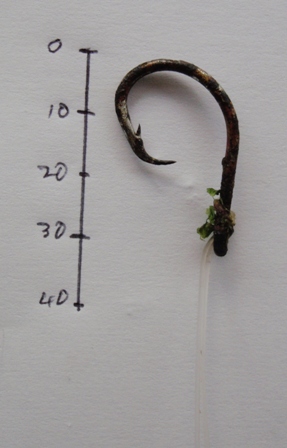
(
Attached photo - Fish do survive if the hook is left in as
opposed to damaging the fish when trying to remove the hook. This hook was taken
out of the bottom jaw of an 8lb bonefish on
12.) The `12 lb. albie you have just landed is vibrating so rapidly that you
can't get the hook out for a quick
release.
Hold the fish upside down on its
back.
13.) You just removed the hook from a
schoolie bluefin tuna of
about 20 lbs. What is the best way of releasing that fish ?
Spear it head first into the
water.
Try for a corner mouth hookup by casting to the side of
the fish so that they take the fly turning away from the direction of stripping.
Change fly to one tied on a circle
hook.
15.) The grouper you hooked on a
Clouser and density compensated fly line has sounded
and gone into the rocks. You can't budge
him.
Release the tension on the line and wait for it to swim
out
16.) You have been fishing for small
bluefin tuna in the 20 lb. to 40 lb. range.
Suddenly a giant tuna of about 700 lbs booms through the school and grabs your
fly.
Clear the line, point the rod at the fish and lock up
the drag to pop the tippett.
7.) You have a guest on your
skiff. Every time a tarpon takes his fly he immediately strikes with the
rod tip and pulls the fly right out of the fish's open
mouth.
Tell him to close his eyes and keep stripping with the
rod tip down and wait to feel tension then firmly strip
strike.
18.) A large tarpon tracks your fly and
follows it but won't take it !
Vary the stripping action - Stip faster or add jerky
motion
19.) A bonefish follows your fly for
quite a distance but doesn't take it.
Vary striping action - stop stripping, pause and then
twitch the fly use a long slow strip.
20.) The whipped loop on the end of
your fly line rubbed on the coral as you fought your last fish and is
coming apart. It is the only line you
brought.
Use a nail knot tied behind an overhand knot in the end
of the flyline or use some light tippett material to whip a new
loop.
21.) You have been fishing with an
intermediate sink fly line. Now the fish are on the flat in water only 12"
deep. You don't have a floating fly
line.
Start stripping as soon as the line unrolls and if
possible shorten the casts.
22.) You have fought a tarpon on a
15' Spey rod. You are in a skiff and cannot get
the fish to the boat by usual means.
Loosen the drag, place the rod in the boat and hand line
the fish
23.) The large striped bass you
are fighting from a skiff dives straight down under the boat on the port side
and then runs under the bottom in the direction of the starboard side. (A
"keel-haul !)
Plunge the rod into the water and move around the boat
until the line is clear of the hull
24.) You are casting to tarpon rolling on
the surface one evening in the
Let the fly sink deep before starting to strip - the rest of the school are hanging deep. ( that's what the small species do here in
Aus)
25.) You just hooked a tarpon as you were
about to pull your retrieved fly from the water. The fish leaps only 10
feet from the skiff. you have 75' feet of fly
line on the deck.
Quickly bow to the fish, keep the rod pointed at the
fish and maintain slight pressure on the line with line hand until all the slack
line is taken up. This prevents the line jumping off the floor in loops and
tangling.
26.) You have just made a cast to a
bonefish which spooked. Your guide points out another approaching from
behind you. He hasn't got time to turn the
skiff.
Off shoulder cast or backhand
cast
27.) The tarpon are feeding in a weed
line. Scattered weeds all over the place on either side
of this line. You are fishing with an intermediate line, but do not
have any weedless
flies.
Cast and hope. Clear any weed off the line as it comes
in. If a large bunch builds up close to the fly, back off on the
drag.
28.) You and your buddy have just
hooked up on two big tarpon ... a double
header.
Two
alternatives
1 - Fight "down and dirty" on one and softly softly on the other. When the first is landed get serious
about the fight on the second.
2 - Toss for who breaks his
off
Nial
~~~~~~~~~~~~~~~~~~~~~~~~~~~~~~~~~~~~~~~~~~~~~~~~~~~~~~~~~~~~~~~~~~~~~~~~~~~~~~~~~~~~~~~~~~~~~~
Nial: You are right about leaving the hook in the fish when you must.
I've caught tuna with one or more old rusty hooks embedded in the jaw. Years ago, I used a magenta/purple marabou salmon fly ("Popsicle") and caught a tarpon..... had to cut the leader. Two months later, I saw that same fish with my salmon fly swimming happily in a school of his compadres !
We've been taught to avoid stainles steel hooks since they won't rust out. I know of no studies which really gives us a good answer to this dilemma. ( I prefer the chemically sharpened hard chromed carbon steel hooks anyway, because I can keep them sharper.)
I become dismayed when I have broken off the entire fly line at the backing connection. Not sure that fish will survive as it drags that fly line around. Just one reason that I'm very careful with that connection ..... placing a segment of mono loop to looped between the Spectra backing and the loop on the rear end of the fly line so the Spectra won't cut through the fly line loop. It's also why I've gotten away from Dacron backing. It's not very abrasion resistant.
That happened to one of the anglers at Homosassa back in the 80's..... That fish dragged the fly line as it tried to swim with the school. Every time he'd turn, he's spook the rest of the school with the belly of that line. Nobody could get a strike from that batch of fish.
Gordy
~~~~~~~~~~~~~~~~~~~~~~~~~~~~~~~~~~~~~~~~~~~~~~~~~~~~~~~~~~~~~~~~~~~~~~~~~~~~~~~~~~~~~~~~~~~~~~~~`
From Jim Valle:
Gordy,
Rene and Group,
Great
post and introspective look at the experience,
Congratulations
to Rene on his fish and progress during his Odyssey
Jim
V
Attachment:
Hook.JPG
Description: JPEG image