Walter & Group...
During casting practice whether with one handed or two handed rods, one of the biggest problems we enconter is FATIGUE. This is particularly true of Master candidates practicing endlessly for their exams.
Fatigue can be due to many factors including the use of more energy than required for the tasks. A very important one is the way we hold our rods. Nothing can produce fatigue, joint pain, and faults more than the "death grip" on the cork.
I've placed two attachments. One many of you have seen before .... it's the super light so-called ROMAN MOSER GRIP first taught to me by Jeff Barefoot. Periodically going to this helps reinforce the concept of a light grip with brief increase only during max loading.
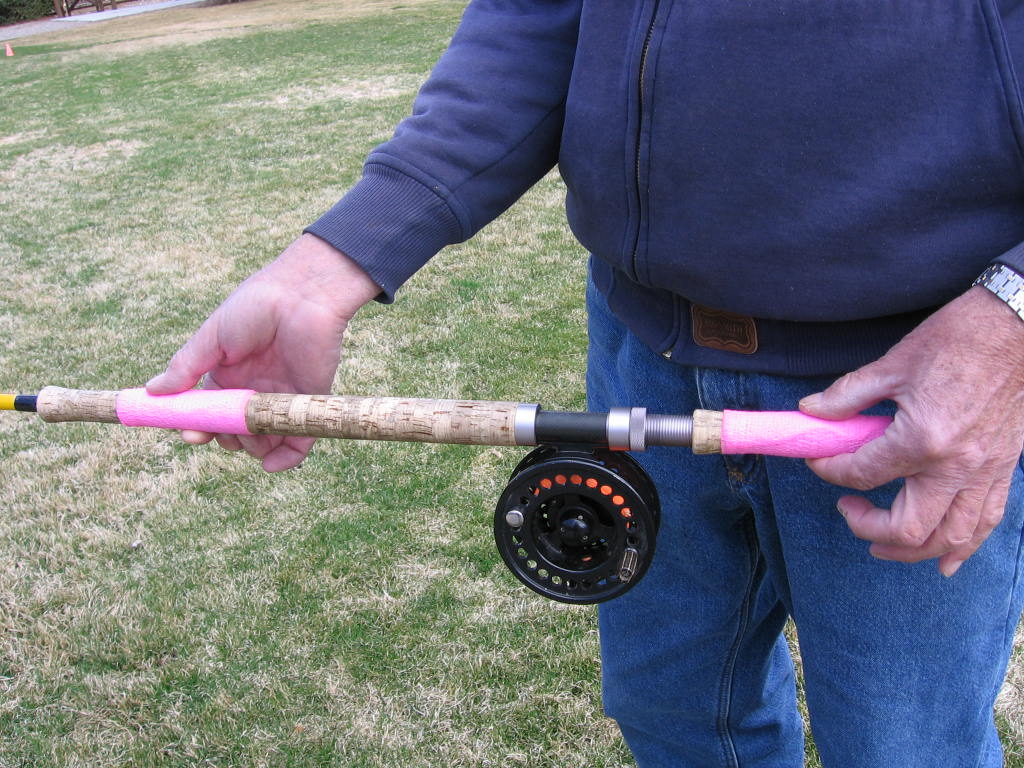
The second is from Kirk Eberhard. Here is his text to go with the picture:
Hi, Group,
Try this ! Only the thumb and a finger of each hand holding the lower corks.
This promotes a light/relaxed grip/hold.
Squeezing/choking the heck out of the grips is a common fault that leads to fatigue and casting faults.
I placed some "vet"wrap on the handles as a reminder ------ light grip, minimize effort, squeeze/release at the stop.
Kirk
~~~~~~~~~~~~~~~~~~~~~~~~~~~~~~~~~~~~~~~~~~~~~~~~~~~~~~~~~~~~~~~~~~~~~~~~~~~~~~~~~~~~~~~
PRACTICING TIGHT LOOPS
~~~~~~~~~~~~~~~~~~~~~~~~~~~~~~~~~~~~~~~~~~~~~~~~~~~~~~~~~~~~~~~~~~~~~~~~~~~~~~~~~~~~~~~~~~~
We've discussed casting with tight loops a great deal in the past. This morning, I lifted this passage by Bruce Richards from Al Crise's Group discussion :
Match the rod arc to rod bend, and apply the right amount of force to the
rod in
a very constant way to assure progressive rod bend, that results in
the
straightest tip path, and that is what makes tight loops. After the
loop is
formed you do need to keep the rod tip high to not pull the bottom
leg
down, but that is much less important than the straight line tip
path.
I see the key statement in this message as: MATCH THE ROD ARC TO THE ROD BEND.
This will result in the rod tip unloading just a small distance below the oncoming line for the ultimate achievment of a tight loop as it begins to form at RSP. (Rod Straight Position)
By using increased rod arc for the rod bend, we get a wide loop. By selectively increasing rod arc relative to rod bend at either the start or end of the cast, we can produce a wide loop with the fly leg up high and the rod leg fairly straight or a concrolled wide loop with the fly leg straight and the rod leg low in that order as we wish.
Using insufficient rod arc for the rod bend, we end up with a tailing loop.
Gordy
~~~~~~~~~~~~~~~~~~~~~~~~~~~~~~~~~~~~~~~~~~~~~~~~~~~~~~~~~~~~~~~~~~~~~~~~~~~~~~~~~~~~~~~
MORE ON PRACTICE
~~~~~~~~~~~~~~~~~~~~~~~~~~~~~~~~~~~~~~~~~~~~~~~~~~~~~~~~~~~~~~~~~~~~~~~~~~~~~~~~~~~~~~~~~~
One method of reducing fatigue when practicing single handed casting.... especially with distance practice:
Make your distance cast. Then place your rod beneath your casting arm (armpit) and use a two handed strip. If you do this between casts, you'll save a lot of energy and hand/arm tireing.
Simply holding your rod in one hand for an hour at a time can yield enough muscle fatigue to affect your casting.
We advise our students to practice in intervals of half an hour or less ..... more frequent shorter practice intervals are much better than the long sessions. HOWEVER, I know our Master candidates don't do that !
(For that very reason, when I'm staked out in my skiff waiting for tarpon to appear, I have the skiff tethered to my bow line and cast from the stern. I have a net over the engine to collect the fly line. Then I put my rod on the push-pole platform positioning it and the line & fly so I can grasp it at an instant and make my cast. Also, staking out or anchoring from the bow, I don't have wave-slap on my transom. )
Gordy
~~~~~~~~~~~~~~~~~~~~~~~~~~~~~~~~~~~~~~~~~~~~~~~~~~~~~~~~~~~~~~~~~~~~~~~~~~~~~~~~~~~~~~~~~~~~~~~~
From Rene Hesse:
~~~~~~~~~~~~~~~~~~~~~~~~~~~~~~~~~~~~~~~~~~~~~~~~~~~~~~~~~~~~~~~~~~~~~~~~~~~~~~~~~~~~~
~~~~~~~~~~~~~~~~~~~~~~~~~~~~~~~~~~~~~~~~~~~~~~~~~~~~~~~~~~~~~~~~~~~~~~~~~~~~~~~~~~~
Attachment:
Two Hand Grip 001.jpg
Description: JPEG image
Attachment:
roman moser.bmp
Description: Binary data