Walter & Group...
I WILL BE AWAY FROM MY MAILLIST CONTROLLER FOR THE NEXT FEW DAYS ...... GORDY
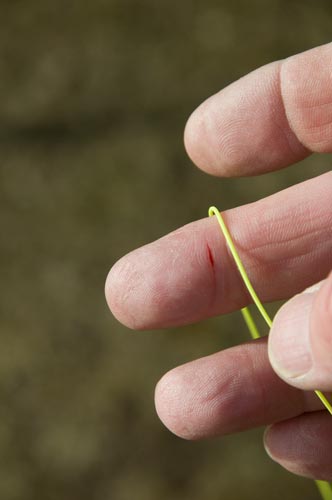
Ally Gowans on finger "cuts" due to fly line stripping (Note his picture attachment) :
I accidentally erased his first message, but can tell you that he called attention to the finger cuts which are more likely to occur with fly lines with textured surfaces such as the Sharkskin lines. He pointed out correctly that this can lead to infections. His picture shows the injury clearly. I asked his permission to send you the picture and answered him as follows:-
Ally...
With many years of blistering runs made by large pelagics like tuna or big
tarpon under my belt I developed, perforce, great respect for what the fly
line can do to the finger at any moment on the strike as I strip.
Now, without thinking at all, I strip with the line going over both index
and third finger and I instinctively keep the line out of the crease on the
volar side of my joints.
For that reason, I didn't have a problem when testing the Sharkskin lines.
Some of our salty guys have learned to put a protective "band aid" over the
vulnerable area of the index finger. I do recommend that with the use of
any line for my friends when I take them out for these fish. Some fly shops
in salt water areas sell various types of finger protectors.
We are particularly interested in avoiding hand injuries, particularly when
handling and cleaning fish for another reason.....
These cuts or punctures can easily get infected by various organisms one of
which can produce a hand tumor or nodule which may require surgery as well
as antibiotics. This is called by the lay term, "fish tuberculosis" since
the organism (Mycobacterium marinum) is related to those of both bovine and
human Tbc.
May I use your finger picture to show the Group ?
Gordy
His answer:-
Hi Gordy,
Yes of course you can use the picture.
Those in contact with contaminated river or lake water may contact
Leptospirosis, a form of leptospiral jaundice known as Weil's Disease.
Infection of the human body by the organism may be through the mucous
membrane of the eyes, nose and mouth, or through cuts or minor abrasions of
the skin. Thorough first aid treatment of all wounds is important.
The incubation period is usually about 7 to 10 days. The early stages of the
disease may be rather like influenza, and the jaundice may be absent.
Best wishes,
Ally Gowans
~~~~~~~~~~~~~~~~~~~~~~~~~~~~~~~~~~~~~~~~~~~~~~~~~~~~~~~~~~~~~~~~~~~~~~~~~~~~~~~~~~~~~~~~~~~~~~~~~~~
Roll Casting - More
~~~~~~~~~~~~~~~~~~~~~~~~~~~~~~~~~~~~~~~~~~~~~~~~~~~~~~~~~~~~~~~~~~~~~~~~~~~~~~~~~~~~~~~~~~~
From Craig Buckbee... My comments in his text in bold blue italics :-
gordy,
vertical or side-arm, doesn't matter, good tracking helps the caster
throw a the line far... hello choir.
Agree.
If you make a standard roll cast with the rod not canted a bit to the casting side and in a perfectly vertical orientation, you stand a chance of being struck by the line or fly ..... particularly if there is any wind from the casting hand side. This is why most of us teach to make the forward delivery of this cast with at least a slightly off vertical rod orientation. I have no quarrel with doing this with the rod more horizontally oriented, though for some casters goodtracking is a bit more difficult to maintain. G.
why use (waste) extra energy to rip line off the water that's laid out in
a circuitous path? i can cast quite far with an airialized oval back cast but
air doesn't stick nearly as much as water. also, instead of the fly having
to be dragged around and be lifted in a curved path, it is pirouetted and
cleanly lifted up and out.
As you know, I do teach that the static D-loop on either the bank or in the water behind the caster should not be formed in a wide semicircle (wide loop) for the reason that you point out very well. Not only for that reason, but the fact that this wide loop even though static, represents some degree of slack.
One trick to make an efficient long roll
cast, is to flip line behind in such a manner as to have a long
narrow D-loop on the bank as close behind the casting elbow as
possible. This doesn't work well when the static D-loop is placed on the
water, because of the inertia produced by the water
resistance. G.
if my roll cast needs to be made with a vertical stroke, then i want the
incoming line (water line, dead line) close to my body (more importantly, under
the tip) to keep the most efficient tracking alignment. too vertical and an
inattentive caster may get whacked by line + fly.
I agree. (Close, but not directly behind your body.) G.
as for Ally's query, "Is there 'power' in a D loop or is there even any
merit in trying to make a D loop quicker than is absolutely necessary?"
well, in roll cast 101 there is no power in the D loop.
but, for a switch cast there certainly is. and if there is tail wind the
caster will want to drive the line back with enough energy to compensate for the
wind.
Yes. I don't see how there can be any power in a static D-loop draped down from the rod tip or lying on the bank or in the water behind the caster. As you point out, there is obvious power in a live line D-loop. It wouldn't be moving if not energized. G.
craig
~~~~~~~~~~~~~~~~~~~~~~~~~~~~~~~~~~~~~~~~~~~~~~~~~~~~~~~~~~~~~~~~~~~~~~~~~~~~~~~~~~~~~
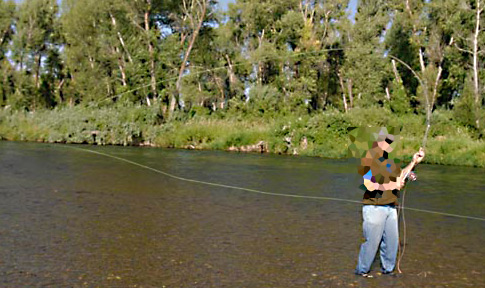
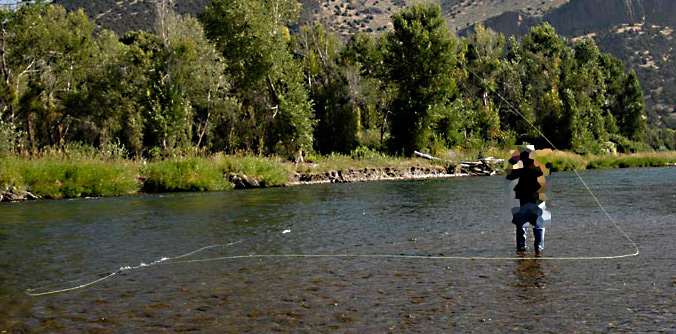
On "D" and "V" loops by Ally Gowans:
(Note his attachment photos)
Hi
Gordy,
Best
wishes,
Ally Gowans
~~~~~~~~~~~~~~~~~~~~~~~~~~~~~~~~~~~~~~~~~~~~~~~~~~~~~~~~~~~~~~~~~~~~~~~~~~~~~~~~~~~~~~~~~~~~~~~~~~~~
Ally.... Not being an expert on Spey casting, I'll not comment further than to say that I'll observe these loops from vantage points other than from the side in order to learn.
Gordy
~~~~~~~~~~~~~~~~~~~~~~~~~~~~~~~~~~~~~~~~~~~~~~~~~~~~~~~~~~~~~~~~~~~~~~~~~~~~~~~~~~~~~~~~~~~~~~~~~~~~
From Bill Hoot :
I like Ally's quote from Edwards and Turner, that a Spey cast is a change-of-direction roll cast. Gary Davison's definition of a Spey cast is even better, it is an aerialized dynamic change-of-direction roll cast [without a stop until at the end of forward cast].
Attachment:
sore_finger.jpg
Description: JPEG image
Attachment:
Vloop_question.jpg
Description: JPEG image
Attachment:
Vloop_question2.jpg
Description: JPEG image