Walter & Group...
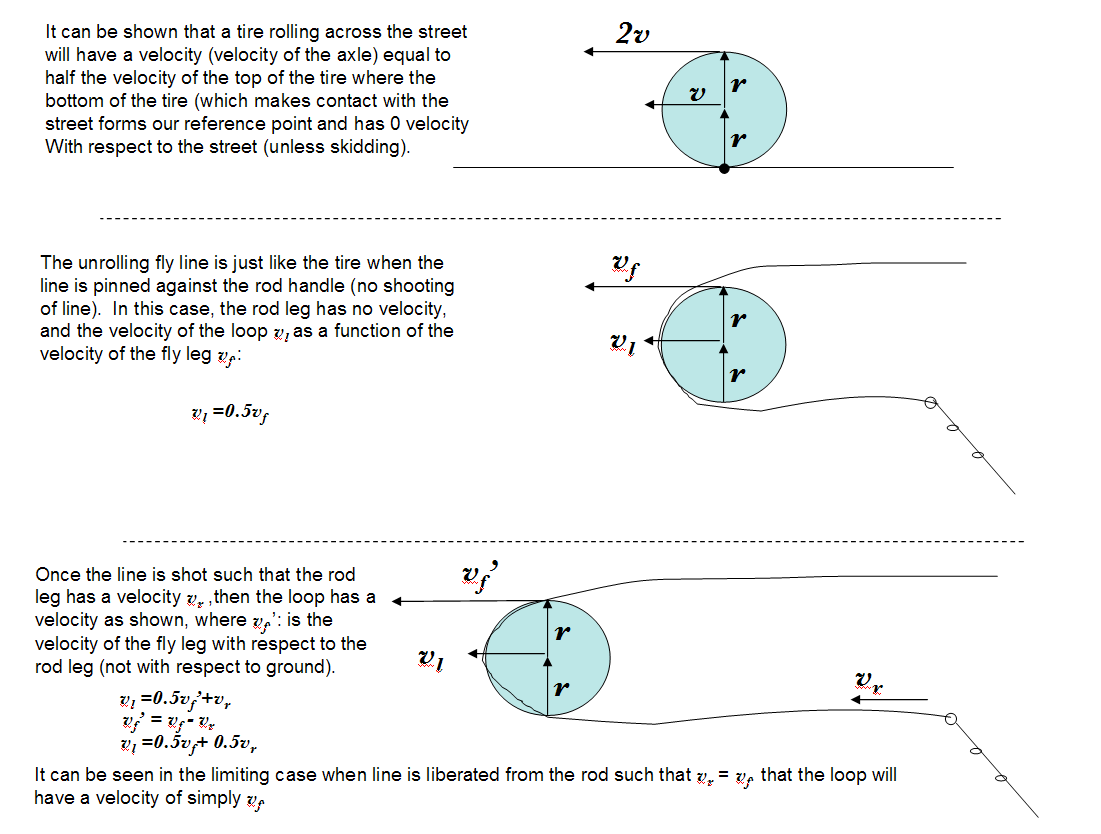
From Dan Storaska on loop velocity note his attachments containing his derivation formulae... (same atttachment in two differerent formats - one in .gif and the other in .ppt ) :-
OMG, I must’ve not
explained it well enough. If I have 15 rank beginner students 1 or 2 of
them will clearly do the “soft stroke” that I’m trying to describe. I do
NOT try to explain to them that they’re not continuing to accelerate, that would
be too heavy for 98% of students. I do ask them to try to maintain the
bend in the rod right up to the end, at the stop. I do the 0 mph, 10 mph,
25 mph, 50 mph, 100 mph, 160 mph… BANG 0 mph thing with them, to get them
thinking about acceleration, which often does the trick. Some people are
exceedingly “ginger” with their brand new 600 dollar flyrod, maybe afraid that
they’re gonna break it. I root them on, saying “You paid a lot of money
for that thing, make sure you get your money’s worth out of it!” with a
big smile on my face. I say “if it ain’t bendin’, it ain’t helpin’ you
with the cast!” still smiling.
If you look at a free
body diagram, an object will respond to forces acting on it (or more accurately,
to the summation of forces acting on it). We also know that F= Ma.
So for a body of mass M, there will be no acceleration if no force. And
vice versa. If you could ignore wind resistance (on the surface area of
the flyrod and drag on the flyline) then you would reach a point where, if you
stop the rod from positively accelerating, the rod would choose to relax
(release its stored/potential energy). This would occur when the rod
reached constant velocity so the rod tip and moving flyline are all in a happy
place, content to move through space at this constant velocity until something
makes them change (new forces introduced).
So, if they don’t
continue to accelerate, I go back to the mph thing. I say that what I’m
seeing is that they’re going 0, 10, 25, 50, 75, 75, 75, 50, 0 mph. That
usually helps. I know, not 100% scientifically accurate, but plenty close
enough to make the point. A la Lefty-style.
It doesn’t really
matter if you’re losing rod loading because the rod is decelerating or at zero
acceleration. Having an unloaded or underloaded rod at the initiation of
the desired (intentional) stop results in lower line/loop speed and a less
efficient cast overall. Doesn’t mean that you can’t MAKE a cast from it,
but it won’t be as good as it could be. I completely agree, Bruce, the
very best casts result from unloading a peak loaded rod at the stop. But
unfortunately, in my opinion, that doesn’t always happen early on with every
student. Some have to consciously learn how to synchronize max load with
the stop, while some arrive at it intuitively.
Regards,
Troy
Miller
~~~~~~~~~~~~~~~~~~~~~~~~~~~~~~~~~~~~~~~~~~~~~~~~~~~~~~~~~~~~~~~~~~~~~~~~~~~~~~~~~~~~~~~~
Troy: I guess the epitome of the "soft stroke" is the one we use to yield what many term the "negative curve cast" or the "decelerating curve cast". Obviously, the caster has to have some acceleration in the beginning of the stroke, then "softens" it by bringing it to zero followed by a period of negative acceleration. An "underpowered" curve layout occurs, but no true loop formation at or near RSP.
This is usually a cast which gains little distance and isn't easy to control, especially if its windy.... but it has its uses on the stream in windless weather when a short curve with gentle and not necessarily accurate presentation is desired.
Gordy
~~~~~~~~~~~~~~~~~~~~~~~~~~~~~~~~~~~~~~~~~~~~~~~~~~~~~~~~~~~~~~~~~~~~~~~~~~~~~~~~~~~~~~~~~
On the commonalities and differences between two handed and single handed casting
~~~~~~~~~~~~~~~~~~~~~~~~~~~~~~~~~~~~~~~~~~~~~~~~~~~~~~~~~~~~~~~~~~~~~~~~~~~~~~~~~~~~~~~~~~~~
From Al Buhr. A brief comment by me in his text in ### italics G. :
Gordy,
Single-hand and 2-hand have countless of common points, in rod mechanics, with casting errors, even the natural steps of how a student learns. For example, a person making their first casts will have a tendency to wrist, likewise, in 2-hand a first time student tends to push the top-hand forward, arcing the rod in the same manner.
#### Leads to my recollection of your analogy between the borders of the hand in single handed casting being akin to the two hands of Spey casting. I never forgot that. To me it explained a lot of things including the ease with which the caster can make Spey casts using a one handed fly rod. G.
Parallel to this, I have helped several
good single-hand instructors develop a common method to teach 2-hand. This way,
each discipline has a common theme fitting to that
instructor.
Ok, lets use Al Kyte’s three portraits of
style: elbow forward, elbow to the side, and elbow low. In 2-hand: Elbow forward
is common to the Underhand techniques. Elbow to the side is a kind to a constant
tension cast technique. Elbow low is common to straight-line long stroke
techniques.
Your comments to today of testing or
proving the obvious are all so true. One of many things Jim Green stressed is
continual review and testing of ideas. Objectively sorting out the cast, single
and 2-hand, is healthy. Concepts that are true will hold, meanwhile greater
depth is gained into the degree fundamentals can be
altered.
Truly enjoying reading along, thanks.
#### Al , in private communication told me that he'd learned of a two handed casting method similar to what we now call Spey casting which was said to have been brought to Italy by Swiss immigrants some 1200 years ago !!! It was called the VALSESIANA WAY .. I've always been fascinated by the old history of fly casting, but hadn't heard of this before. If true, that would vastly pre-date the information about Dame Juliana Berner.
Perhaps Raf and Mauro can tell us more (??????) ...... G.
What I know of it was told to me by Raf and
Mauro during my stay. The details of the name I cannot answer. I believe there
is a booklet on the technique, written in Italian. The river I fished was the
Valsesi. At that location the older homes in the surrounding area are Swiss and
of stone construction.
I now have a (valsesiana) rod, 3.2 meter and horse hair line to match. Yes, woven horse hair, hand woven, knotted sections develop the taper, total length about 4 meters. The line is fixed to the rod tip, when a fish is hooked there is no line-out or in, just a burst of running speed to keep in step. The rod/line combination is very nice to cast, the long rod length brings “high-sticking” to a new dimension. Traditionally a brace of three to four small wet flies where used and is why the moves we know as spey now where (are) so effective. I used this rod and technique with caddis drys and found getting a drag free drift super easy.
### Years ago, I was introduced to a method called, "poke pole fishing" in Northern California. It was usually done with bait.... however, some used a big feather fly. It was tied to a stout mono line afixed to the tip of an 18' Tonkin cane pole. We fished it by crawling and jumping out onto the rocks in the surf and literally "poking" it straight down into the sudsy wash deep in the cravasses betwen the rocks and swishing it about. Every now and then, we'd hook a monkey faced eel or a cabazoni or kelp greenling.
My father (Pop Hill Sr.) wrote one of the original articles for Field & Stream on the use of a similar arrangement being used to catch snook at Punta Gorda, Florida. The "fly" was just a piece of rag whipped to a hook and swished in the current under bridges at the shadow line ..... G.
Al
~~~~~~~~~~~~~~~~~~~~~~~~~~~~~~~~~~~~~~~~~~~~~~~~~~~~~~~~~~~~~~~~~~~~~~~~~~~~~~~~~~~~~~~~~~~~~~~~
Attachment:
definition of loop velocity.gif
Description: GIF image
Attachment:
definition of loop velocity.ppt
Description: Binary data