[Date Prev][Date Next][Thread Prev][Thread Next]
  • Thread Index
  • Date Index
  • Subject Index
  • Uni Knot / Duncan loop


    Walter & Group...


    From Rene Hesse...

    Gordy,

    I haven't looked anything up on the uni-knot vs Duncan loop debate but based on experience (limited in terms)

    the way you tie the knot is the same.  The only difference is how you finish it....with a loop by working the tag end tight with 'wiggle room' for the eye of the hook, or bringing the wraps all the way down to the eye and then tightening there. 


    That knot is great for poor eye sight conditions


    Rene

    ~~~~~~~~~~~~~~~~~~~~~~~~~~~~~~~~~~~~~~~~~~~~~~~~~~~~~~~~~~~~~~~~~~~~~~~~~~~~~~~~~~~~~~~

    Rene....  

    True about the poor sight conditions.  That is one I can tie in the dark on one of my dawn patrols at, "O-Dark hundred hours".

    (Did that this morning.)

    Looking it up will improve your eduction !

    Gordy

    ~~~~~~~~~~~~~~~~~~~~~~~~~~~~~~~~~~~~~~~~~~~~~~~~~~~~~~~~~~~~~~~~~~~~~~~~~~~~~~~~~~~~~~

    From Tony Loader:-

    Hi Gordy,


    Although some, e.g.  http://www.killroys.com/knots/duncan.htm

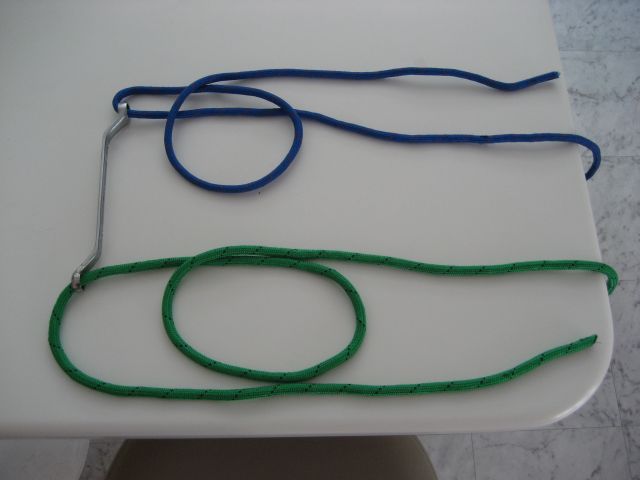
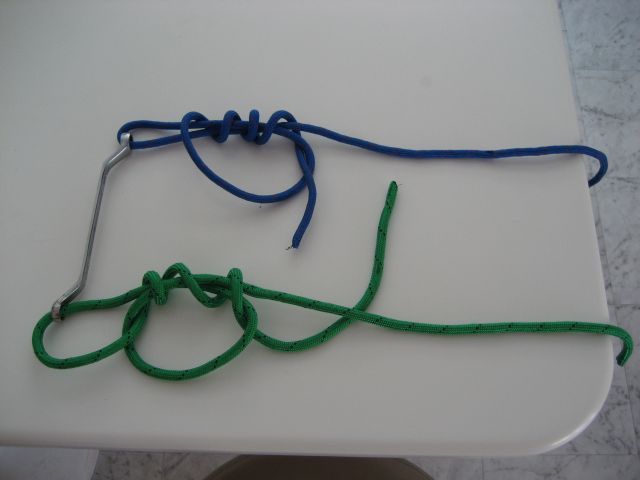
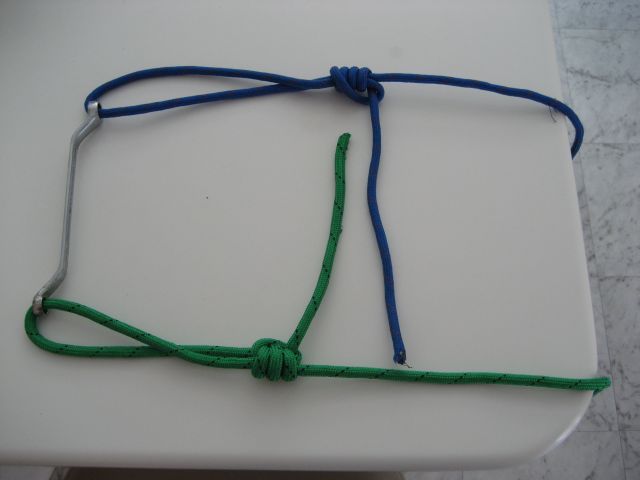
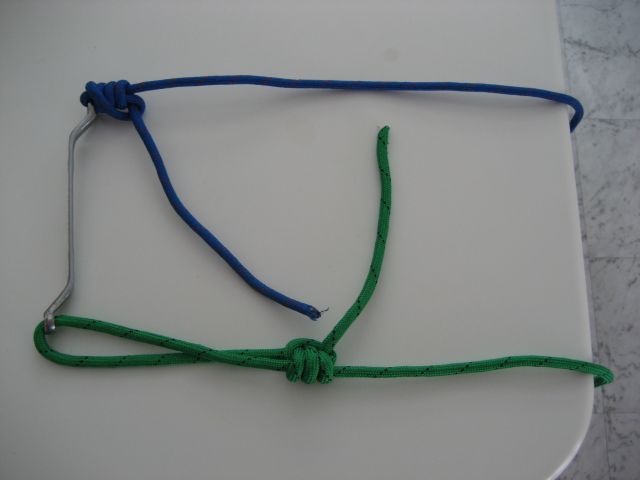
    apparently disagree, I believe there is a critical difference. For the Uniknot, the entire knot is bent ONTO the standing end while for Duncan’s loop the final spiral is bent INTO a loop in the standing end. Thus the Uniknot is a slip knot while Duncan’s Loop is not.


    Four pictures attached.


    Great work from Jerry. Thanks.


    Regards,

    Tony.

    ~~~~~~~~~~~~~~~~~~~~~~~~~~~~~~~~~~~~~~~~~~~~~~~~~~~~~~~~~~~~~~~~~~~~~~~~~~~~~~~~~~~~~~~~

    Tony...

    I was able to open the attachments.  (They show the tie sequence)    The green line shows what I would consider a different knot than either the Duncan or the Uni ..... though very similar except for that one turn.  Clever !  I hadn't seen that one before.    

    That Duncan loop depicted in your link to Kilroy's knots will slip down.  It is simply a matter of getting it tight enough to increase friction sufficiently that it takes a lot of force to do it.  I tighten it by maintaining the loop diameter as I pass the loop over a nail or post (or hook the fly onto a ring  on my skiff console), then pull firmly on both the tag and sanding ends at the same time.

    Gordy

    ~~~~~~~~~~~~~~~~~~~~~~~~~~~~~~~~~~~~~~~~~~~~~~~~~~~~~~~~~~~~~~~~~~~~~~~~~~~~~~~~~~~~~~~

    From Lewis Hinks:

    Gordy,
     
    I am looking forward to the answers as I can see no difference between these two knots, other than intent. If loop is left open it is a Duncan, if closed it is a Uni.


    Lewis
    ~~~~~~~~~~~~~~~~~~~~~~~~~~~~~~~~~~~~~~~~~~~~~~~~~~~~~~~~~~~~~~~~~~~~~~~~~~~~~~~~~~~~~~~~~~~~~~~~~~~
       I sent this answer to Mack , then added a lot more detail for the Group :- 

    Mack....
     
    Both slip.  The difference, I see, is that the Duncan loop is a true loop whereas the uni knot can be used as a line splice.  When used that way, the two uni knots have slipped down upon one another and become stable without further slippage.
     
    In his book, FLYCASTING SYSTEMS, p. 18, Bill Nash has this to say about the Duncan loop: "An adjustable loop to be used with nymphs, wets and streamers when a more natural free swimming action is desired, to make a slip knot loop for connecting to an arbor, ..........." 
     
    Quoting Lefty Kreh; PRESENTING THE FLY, p. 111 : " The most popular loop knot is the uni-knot, formerly called the Duncan Loop.  This knot isn't as strong as the tippet with which it's tied".  Lefty classifies the Uni knot as in the class of clinch knots. (p. 104.) 
     
    When I use the Duncan loop to tie my tippet to the fly I know that  while playing a large, powerful fish that it often slips down tight on to the hook eye.  That's OK, since I'm likely to land the creature anyway.  Having done that, I'll usually re-tie so that I have the fly able to swing freely in a new loop. 
     
    One advantage of the Duncan Loop (Uni loop) is that I can tie it easily in the dark.  It's simple, easy to teach, and the standing part comes straight out of the body of the knot allowing good tracking of your fly when that is desired.  Another advantage is that it is easy to accurately determine the size of the loop as you tighten it in contrast to many other loop knots including the, "non-slip loop" and the perfection loop.  Lastly, it makes a smooth, neat knot which goes through the guides with relative ease. I sometimes use this knot to attach a heavy shock tippet ("bite tippet") to the hook for tarpon fishing.  Here, strength is unimportant because we're using material of anywhere from 40 lb. to 80 lb. test.
     
    Years ago, my brother, Dave Hill was fighting a 600 lb. black marlin off Panama.  The reel froze.  We backed down to give slack to the critter and I quickly cut his line and made a double uni-knot connection to the line on another reel .  Came tight as I clinched it down.  He landed the fish.
     
    This uni knot makes no loop nor is it fastened to a hook eye.  You tie it around one line, then you use the tag end of the line about which it was tied and make another uni knot around the first line.  They are each tightened down separatly, then are pulled together to form a line splice.  (Similar to a nail knot splice for joining two lines.)  Some use this instead of barrel knots or blood knots when making up leaders. Tom White used double nail knot splices for the tapered section of his big game leaders.
     
    In, FISH ON, Floyd Franke writes: "Among the contenders for best knot to use when joining backing to the reel arbor are the Arbor knot and the Duncan Loop or uni-knot. Although the Arbor knot is most often used, I prefer the uni-knot because it has better shock strength." Lefty and I tested these, however, and found the uni-knot was not superior in strength to the arbor knot. (We probably used different methods of testing.)
     
    Al Kyte writes in, FLY FISHING, SIMPLE TO SOPHISTICATED, p. 172, The slip-knot feature of the Duncan's loop or uni knot allows you to fish nymphs with a little extra swimming action." 
     
    Tom White and I noted something interesting when we used uni-loops (Duncan's) at various points on our big game fly leaders.  The farther from the fly, the less likely that the loop would slip down tight while fighting a fish.  While the loop to the fly often pulled down and slipped all the way to the hook eye, the same loop tied up at the other end of the leader system on the butt section when loop-to-looped to the fly line never did slip down.
     
    Some use the term, "uni-knot loop" interchangeably with that of, "Duncan loop".
     
    I won't  post this until I ask your question of the Group.
     
    Gordy
     
    ~~~~~~~~~~~~~~~~~~~~~~~~~~~~~~~~~~~~~~~~~~~~~~~~~~~~~~~~~~~~~~~~~~~~~~~~~~~~~~~~~~~~~~~~~~~~~~~~~~~


    Attachment: Uni v Dunc1.jpg
    Description: JPEG image

    Attachment: Uni v Dunc2.jpg
    Description: JPEG image

    Attachment: Uni v Dunc3.jpg
    Description: JPEG image

    Attachment: Uni v Dunc4.jpg
    Description: JPEG image