|
Walter & Group....
[GH] Let's fill in some of our information gaps which, I think, will clarify some of the issues we've discussed on loop formation:
Frank Harford reminds us of the date of our detailed Slide Loading messages:
Gordy
That discussion on slide loading was in 7/5/09
Frank
~~~~~~~~~~~~~~~~~~~~~~~~~~~~~~~~~~~~~~~~~~~~~~~~~~~~~~~~~~~~~~
>From Bob Dionne:
Gordy and Bruce,
Thank you for your insights on my flawed answers (twice). This has REALLY helped me and I now have a much better understanding of the timing of haul stops.
I've read Bruce's excellent explanation of loop size formation about twenty times and comprehend most of it but am struggling with my understanding of "the position of rod tip at max counterflex, between RSP1 and RSP2"," very large bottom leg belly" and "bottom leg bump". Could you expand on those topics a bit and/or direct me to other information on those topics? Thanks again.
Bob
~~~~~~~~~~~~~~~~~~~~~~~~~~~~~~~~~~~~~~~~~~~~~~~~~~~~~~~~~~~~~~
[GH] Bob,
No "flawed answers" here!! We are all learning. Along the way, I assure you, I've made more errors than you could.
By calling attention to these things, you contribute greatly to what we are doing here. Not everyone has the guts to jump in and do that. Those who do learn the most.
You are not alone with your wonderment on how these labels are applied and asking for a better explanation of the path the rod tip takes related to what is going on with the line in terms of loop formation.
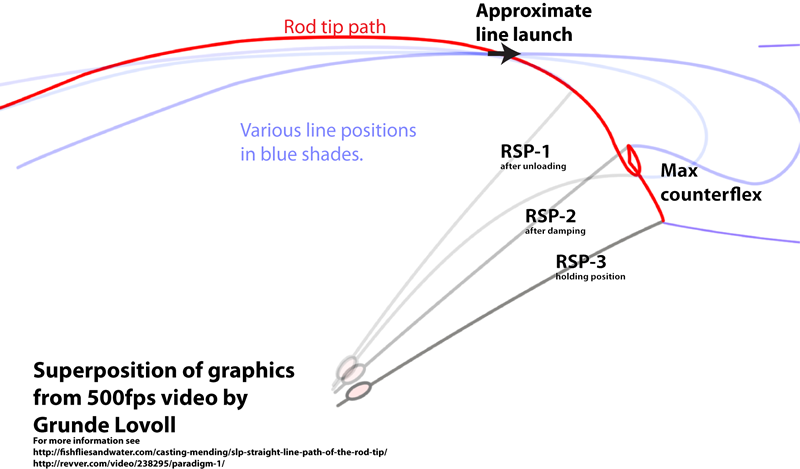
I, and others, are sometimes guilty of making the assumption that everyone knows what we mean by, "RSP 1", "RSP 2", "Point of line launch", "MCF (Maximum Counterflex"), "RSP 3", etc.
Here is my brief written explanation:
One tenth of a second after the STOP of the casting hand, the rod tip has been traveling at its maximum speed. This is the point where the rod becomes straight and the loop starts to form as the line begins to overtake the rod tip. We call this first rod straight position, RSP 1. THE ROD DOES NOT STOP HERE, but continues to flex in the opposite (downward) direction. We call that COUNTERFLEX which means that the rod is bending in the opposite direction than it did during the casting stroke.
That downward bend called counterflex pulls the bottom leg of the newly formed loop down from the straight top leg briefly. It is this "pull down" which opens up and temporarily widens the loop. The rod tip keeps going down and when it gets as far as it can, we call that, MAXIMUM COUNTERFLEX or MCF.
The more flexible the fly rod, the greater the counterflex is likely to be.
Now, the rod bounces back up. We call that, REBOUND. It goes to the point of a second rod straight position which we call, Rod Straight Position 2 (RSP 2). After that, it may have a few vibrations depending upon the stiffness of the rod and the speed of the rod tip before it reverses its track and goes down to its resting position at RSP 3.
That down and up of the rod tip right after loop formation is what makes what Bruce called a "bump" in the configuration of the bottom leg of the loop. This is also where the loop temporarily widens.
That bump can be straightened out partially or completely depending upon the tension of the forward traveling loop.
If that bump is completely eliminated by this action, then the loop can become the same size as a loop made with less counterflex by the use of a faster action fly rod (stiffer).
I'll include the diagram which shows these things.
You have asked for other information:
1. Here is a detailed article by Grunde Lovolle and Jason Borger which requires careful study. It contains a mountain of information.
2. In our next Group message, I'll include a very easy to understand PowerPoint presentation of loop formation with a distance cast sent by Bruce Richards.
Gordy
~~~~~~~~~~~~~~~~~~~~~~~~~~~~~~~~~~~~~~~~~~~~~~~~~~~~~~~~~~~~~~~~~~~~~~~
[GH] Grunde Lovolle produced a great graphic depiction which explains much of this.
Ally Gowans superimposed various line paths and added some additional labels.
I have placed this in an attachment.
Gordy
~~~~~~~~~~~~~~~~~~~~~~~~~~~~~~~~~~~~~~~~~~~~~~~~~~~~~~~~~~~~~
>From Bruce Richards:
Gordy, a very impressive round-up of all the discussions. I doubt there is as comprehensive a listing of haul facts anywhere. I have just two quick comments to make:
"# The CHECK HAUL usually shortens the casting distance. "
- The only way I can think of that a check haul would not decrease cast distance is if the cast was underpowered to start with. Without a check haul the line/leader wouldn't turn over and fall well short. With a check, turnover could be accomplished which would increase distance compared to the collapsed cast.
"# From a mechanics standpoint, it is probably more accurate to use terms such as, "smooth acceleration" and "constant acceleration" to come closer to what actually occurs during efficient casting. Having said that, a 1:1 perfect slope of acceleration may not actually be possible in fly casting. Idea is to come as close to that as a caster can."
- I agree, 1:1 may not be possible. The lowest ratio I've seen is 1.3, getting below 2.0 takes a lot of concentration and practice. Loops made with these very low smoothness ratios are fabulous with top legs arrow straight, but I'm not sure they are functionally better than loops with ratios in the 2-3 range.
Bruce
~~~~~~~~~~~~~~~~~~~~~~~~~~~~~~~~~~~~~~~~~~~~~~~~~~~~~~~~~~~~~
[GH] From Jim Gill:
Gordy,
I couldn't agree more with Bruce Richards' comments - unless an instructor/coach has a reasonable depth of the mechanics/physics of casting dynamics they would not be able to observe properly and therefore analyse and give constructive feedback. Whilst a certain amount of detail in these discussions leave me numb it does provokes me to go and find out more. The benefits are I improve my knowledge and skill (to reduce the jargon to everyday language) and I can be more responsive to my client/student needs.
Regards, Jim.
~~~~~~~~~~~~~~~~~~~~~~~~~~~~~~~~~~~~~~~~~~~~~~~~~~~~~~~~~~~~~~~~~~~~~~~
|
Attachment:
Line Launch -3.png
Description: PNG image