|
Walter & Group...
[GH] Before we get into the second part of the Salt water quick cast task (the problems encountered when wading a flat), lets look at some tips :
~~~~~~~~~~~~~~~~~~~~~~~~~~~~~~~~~~~~~~~~~~~~~~~~~~~~~~
[GH] From Frank Harford :
Gordy
Dave Barron has drilled into my head that the first maneuver in the salt water quick cast is to turn around to see where the guide is so as to avoid hitting him .
Frank Harford
~~~~~~~~~~~~~~~~~~~~~~~~~~~~~~~~~~~~~~~~~~~~~~~~~~~~~
[GH] Frank,
Dave has given you prime advice !
I recall one of our guides who gets anxious when a novice flats fisher is on his casting deck and starts to place his back casts too close to him. He yells out, "Love your guide "!!!!!
Gordy
~~~~~~~~~~~~~~~~~~~~~~~~~~~~~~~~~~~~~~~~~~~~~~~~~~~~~~
[GH] Peter Minnick sends this :
Gordy...
I missed your string of SW quick cast being out of town for a few days... You certainly covered everything and would like to add being "aware of where your line and fly is and what it is doing at all times ",
While on the bow in quick cast mode I'm constantly checking my line and fly so that I'm always ready to cast...also it helps to have the line on the downwind side of your body so that it doesn't interfere with the cast.. I find myself checking "all systems" including the line stack every minute...
Peter
~~~~~~~~~~~~~~~~~~~~~~~~~~~~~~~~~~~~~~~~~~~~~~~~~~~~~~~~~~~~~
[GH] Peter...
Yes, indeed. Line handling is as important as the cast itself !
I neglected to mention that our problem caster had his line on the side of the quartering wind ... not directly downwind, but enough that this contributed to the problem.
Here are a few experiences and things I've learned over more than 60 years of fly fishing from flats skiffs :
We've all had the problem of inadvertently standing on the line with obvious results. Here in the tropics, many of us go barefoot so we can feel the line when that happens .... but in cooler climes, that is a frequent problem. If I have an angler who is prone to sunburned feet, I recommend wearing socks. Keeps the sunburn risk down, but allows the angler to feel the line with the foot.
Moving the foot while standing on the line is a prime way of getting a nasty twist in the fly line.
Stripping out more line than you can cast with these techniques can hurt you. That extra line very much increases the likelihood of a tangle. The way to prevent this is to make a couple of "clear casts" and reel up any extra line not shot.
Lefty's simple technique of shooting the line through a ring made by the thumb and forefinger of the line hand can reduce the number of tangles. * When I'm excited, I sometimes forget to do this. In order to avoid taking your eyes off the fish when this happens, all you have to do is to slide your line hand up the blank to the first stripping guide. The line is always there.
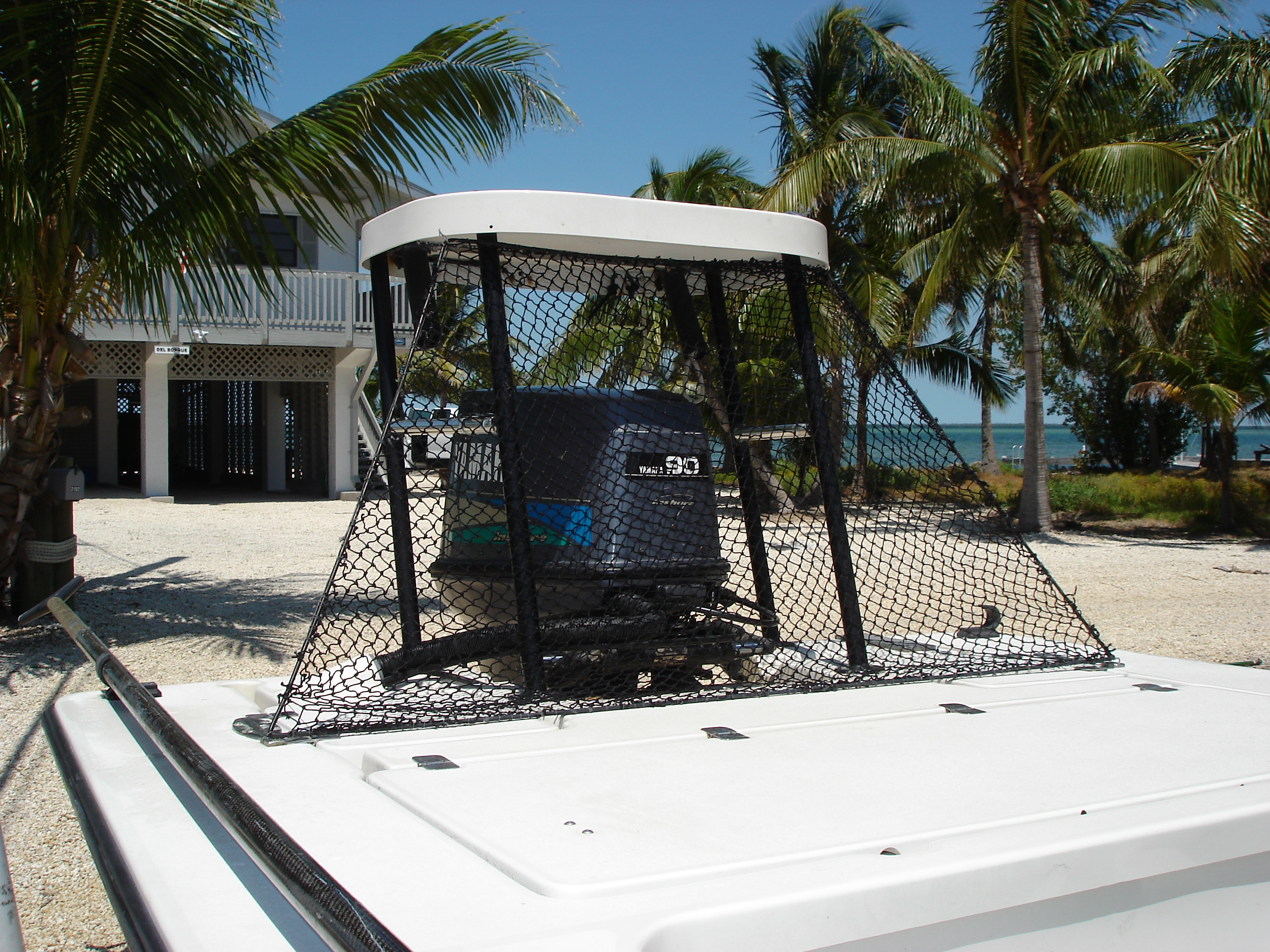
Often, I stake out from the bow and cast from the stern deck. I do this so the wave slap agains the skiff doesn't spook oncoming fish on the flat, since it keeps the bow into the wind. I have made a net which is fastened from my poling tower to the aft deck to keep the wind from blowing coils of fly line into the outboard engine. **
One hint .... When windy, I stand at the aft end of my casting foredeck with my line side foot right at the cockpit edge. I strip my line back AND DOWN onto the cockpit floor. My leg serves as sort of a line guide as I do this.
When I have inexperienced anglers, I show them this. They do it at first, but then, in the excitement which follows, they tend to get farther and farther forward until they risk the line blowing into the water or under foot. (A new application for the term, "creep"). Years ago, my angler did this. He hooked a tarpon and stepped right off the bow ! Lost the fish and the shock sent me flying right off the poling platform into the skiff.
Once, when fishing with a buddy for giant tarpon at Homosassa, our guide was maneuvering the skiff with electric motors, stern mounted. My buddy allowed his line to drag in the water. (no weeds). When the guide started those motors with full thrust, the fly line was drawn into the propellers and cut off.
One problem with maintaining multiple coils of line in the line hand is that there can be long periods of time between fish sightings. In that situation, the fingers fatigue and the coils tend to get crossed leading to a casting failure as they tangle on the presentation. Holding the fly for long periods can cramp the hand. I place my fly with the hook point impaled on a little Velcro disk stuck to the reel seat. Just takes a second to pluck it free if I spot a fish.
Some anglers tuck coils of line inside their belt or waistband. Somebody came up with a belt hook for that purpose. I haven't tried either.
Stripping baskets, buckets, and commercial "Line Tamers" do a good job of holding the line coils. They get in my way, so I don't use them. I joke that they are "for people who can't handle fly lines". They have, however, proven effective when jumping from spot to spot while tournament fishing because you can keep the rod/reel and coiled line in the Tamer ready for instant use.
In that same "waiting game" situation, tight coils on the deck or cockpit can get stuck together in the heat of the tropical sun. Best to have the coils as big as practical which makes this a bit less likely.
Some anglers are better than others at being able to stay "on point" for long periods without fatiguing much. One of my buddies amazes me by being able to do that , "cocked & loaded with the hammer back" all afternoon! I can't do that.
With 2 anglers, using Lefty's method of changing who's "up" every half hour helps negate those problems. Neither angler gets "stale".
* PRESENTING THE FLY, by Lefty Kreh, 1999, pp. 155-157.
** Attached: Photo of my flats skiff with net.
Gordy
|
Attachment:
Maverick 004.jpg
Description: JPEG image