Walter & Group....
Several of you said that you didn't receive this message .... so here it is :
[GH] From Ben Foo:
Hi Gordy,
I have learnt so many tips and techniques from the recent discussions on saltwater casting. Please do keep the good stuff coming. Thank you for your tireless efforts in moderating this Study Group of ours.
Cheers,
Ben Foo
CCI - Malaysia
~~~~~~~~~~~~~~~~~~~~~~~~~~~~~~~~~~~~~~~~~~~~~~~~~~~~~~~~
[GH] From Jim Gill :
Gordy, To someone like me who is inexperienced at this type of angling this series has been very educational - I have a lot of notes to ponder on and it will certainly be of use as I prepare for my next stage of coaching development.
Regards, Jim.
~~~~~~~~~~~~~~~~~~~~~~~~~~~~~~~~~~~~~~~~~~~~~~~~~~~~~~~~
[GH] Jim,
I'm glad you find this material of interest. It's my "thing"...and I live it and love it.
I also love sharing different methods of fly fishing with experienced fishers around the World. We can learn a great deal that way.
Gordy
~~~~~~~~~~~~~~~~~~~~~~~~~~~~~~~~~~~~~~~~~~~~~~~~~~~~~~~~
[GH] Walter Simbirski sends a message of encouragement from Alberta, Canada:
Gordy,
I may not have much salt water experience to contribute to the conversation but the times I was out with you and Tom were some of the most memorable of my life. Keep talking about salt for as long as you like.
Other than the obvious differences between salt and fresh water there were two things that I found a bit surprising during my brief exposure to salt:
- the use of the term hatch to mean something that is similar but different when talking fresh and salt water
- the complexity of the knots used in salt water fishing
The birch bark canoe is put away again for now. We are having another snow week on the tundra.
Cheers!
Walter
~~~~~~~~~~~~~~~~~~~~~~~~~~~~~~~~~~~~~~~~~~~~~~~~~~~~~~~~~
[GH] Walter,
Well... you have caught a tarpon on fly. Not everybody can say that.
Let's clear the "hatch" thing up for others.
We use the term "hatch" with tongue-in-cheek, to describe the early morning sudden appearance of thousands of shrimp on the surface. The birds and small tarpon gorge themselves on them. Lasts for about an hour or so. Fishing fantastic as long as it lasts. These are relatively small adult shrimp ... not newly hatched larvae.
You see, Key West pink shrimp are in the water column at night. At dawn, they almost always burrow down in the sand. That is why commercial shrimping here is done at night only. (I've fished the Pacific off Ecuador and Peru where their white shrimp do just the opposite, so the commercial boats there fish during the day.)
I've witnessed tremendous concentrations of what folks call "jelly prawns" on the shoreline of the Gulf of Carpentaria, Northern Australia, in the daytime. No one called that a "hatch".
We know of certain conditions which favor these "hatches".
The guides in Key West, sometimes refer to a "Guppy hatch". This is the sudden early morning appearance of salt water adult minnows.
Speaking of different terms; most salty fly fishers I knew (precious few) during the 30's and 40's used the term, "mend" to mean taking up slack after a presentation. Nothing to do with the way the fresh water guys used it, of course.
When hooked up to something big and ferocious, you want good knots... more importantly, ones which are tied and drawn down correctly. (Lefty has pointed out to us that a poor knot tied well may prove to hold better than a good knot tied badly.)
Gordy
~~~~~~~~~~~~~~~~~~~~~~~~~~~~~~~~~~~~~~~~~~~~~~~~~~~~~~~~~
[GH] From David Edens:
I have seen films of the tide roaring into the Bay of Fundy, but have never seen it in person.
A few quick questions., When do you have time for charters? This study group must take a tremendous amount of time.
I also run a Maverick HPXV.
Concerning the quick cast. I teach it by holding the fly in the line hand,15 our so ft of line out the tip, and line on the deck. Then I show the student to cross his hand holding the fly under the rod hand/arm while making a roll cast, then one back cast and shoot the line.
I noticed one other person mentioned crossing under the rod hand. I do not hold coils. That is too much for my clients to think about.
I hope I am teaching it correctly. I am self taught on this technique, including a few articles-Joan's book being one-I have read.
David
~~~~~~~~~~~~~~~~~~~~~~~~~~~~~~~~~~~~~~~~~~~~~~~~~~~~~
[GH] David,
I'm not a fishing guide. I take my friends out fishing. Most of them are expert salty fly fishers. A lot of the time, I fish alone. (I'm a retired orthopedic surgeon).
Over the years, I've assisted several flats guides who used to fish spin and bait, to become proficient in fly casting and teaching. In these times, they are much more successful once becoming fly-fishing guides.
I do spend lots of time on our Study Group. (More than you may imagine).
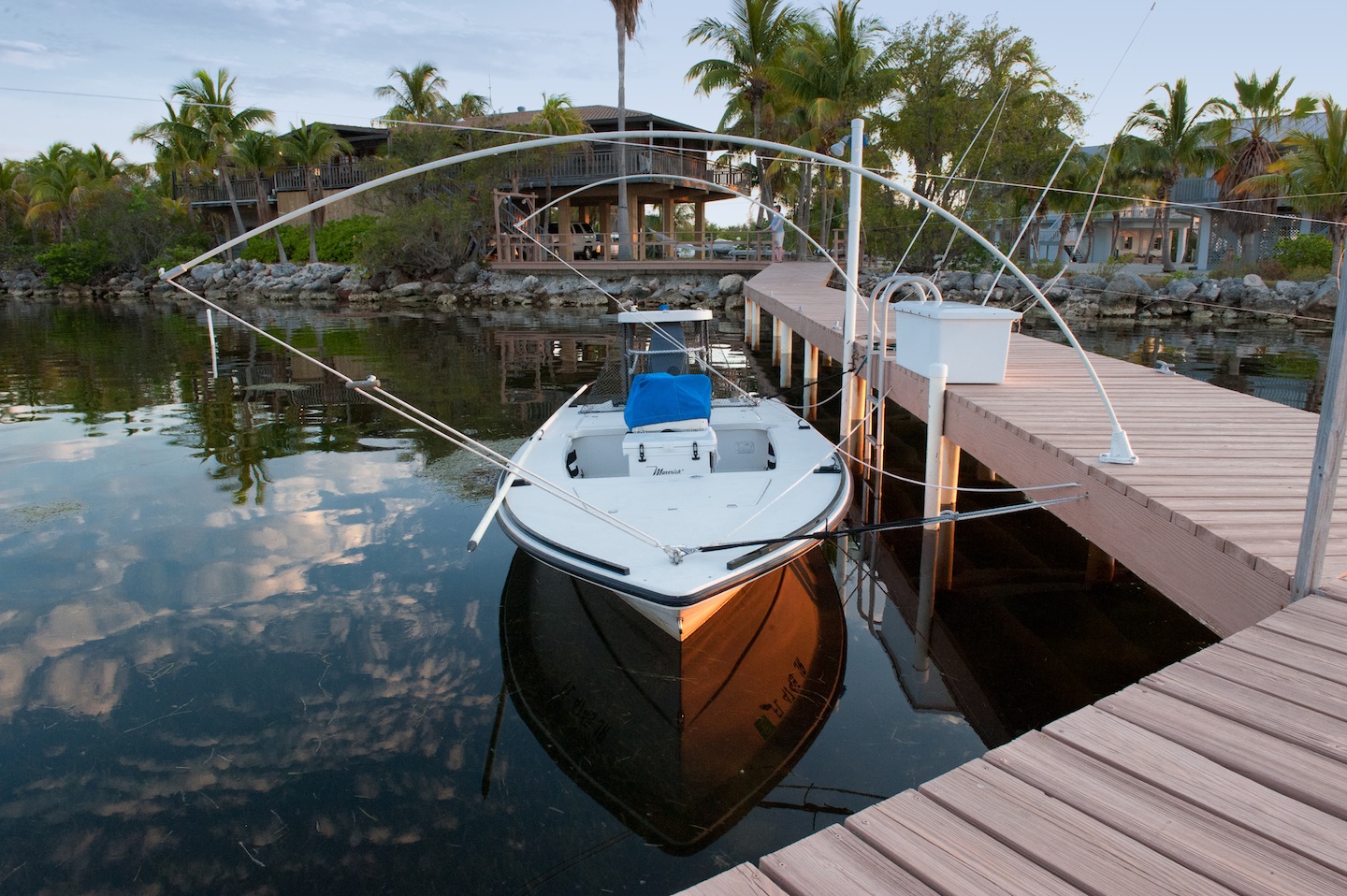
My skiff is a 16 year old Maverick Mirage II. I had the deck, etc. custom made by the factory. Lots of other customizing which I did, myself. Suits me just fine.
I live in the Florida Keys on the waterfront and have my skiff in the water ready to go fish at any time. My fly rods are all rigged up in advance and ready. I also tie my own flies. I used to make up my own rods. Rather than spending a whole day fishing, as a rule, I target certain tides, etc. Sometimes I take a few days to travel.... then I let the Group know I'll be away for a while. We resume upon my return.
Your method of making this cast is a good one !
Takes lots of practice and regular use of these casts to be reliable holding those coils. Not only that, but the hand fatigues when there are long waits between shots. That is when tangles are most likely to occur.
When I stake out or anchor from the bow and fish from the stern, I don't even hold my rod !! I lay it across the poling platform with the tip facing aft. Just enough line is out of the rod tip so it doesn't drag in the water. Line coils from the reel lie on the deck or, if the wind is blowing like blazes, against that net. The fly is on the reel seat with the hook point held by a little disk of sticky back Velcro which I stuck onto the back of the reel seat. As fish approach my ambush position I can grasp the rod and get off a cast in a heart beat.
This is a picture of my skiff at my home dock on Big Pine Key. I can catch tarpon and other species on the flats within sight of my home.
Gordy
~~~~~~~~~~~~~~~~~~~~~~~~~~~~~~~~~~~~~~~~~~~~~~~~~~~~~
[GH] From Bob Stouffer:
Dr. Gordy
Fishing with Billy Glenn off of Harker's Island for False Albacore. No bait pods. No birds. Just the occasional single or double fish. Swimming quickly towards the boat. Boat on drift. Ready position. Fifty foot cast with TT salt lines.
Bob Stouffer
~~~~~~~~~~~~~~~~~~~~~~~~~~~~~~~~~~~~~~~~~~~~~~~~~~~~~~~
[GH] Bob,
Sometimes I fish these "albies" (AKA "little tunny", and in S. Florida, as "bonita") . The "mackerel tuna" I've caught in Australian waters looks identical. *
On Long Island, N.Y. waters, Martha's Vineyard and Nantucket I used a version of that Triangle Taper line which is labelled, "Bermuda Triangle". It is a fairly clear intermediate line. I use it even with surface feeding fish. To make it behave like a WF Floating line, I simply do a check haul and start my retrieve just before my leader loop unfurls and lands. That way it never really gets a chance to sink much at all.
With poppers, this line is allowed to sink just a bit .... keeps the fish from knocking the popper away as they try to get it. Also, if I let the line sink a little more and then pop the popper, it leaves an enticing trail of bubbles.
If the fish go deep, or deep running striped bass appear, I can quickly switch to a weighted Clouser without changing lines or outfits with that line.
Gordy
~~~~~~~~~~~~~~~~~~~~~~~~~~~~~~~~~~~~~~~~~~~~~~~~~~~~~~
[GH] Speed casts for selecting fresh water fish, by John Field :
Hi Gordy,
To add to the freshwater list: The Quick Cast is also effective when sight fishing from a boat for pike, muskie, lake trout and carp, when they are in the shallows. I’ve done a lot of sight fishing for pike after ice-out using the Quick Cast with Larry Dahlberg and others, all over Canada. This technique helps single out the big one you want, from smaller ones you might not want to disturb.
John Field
~~~~~~~~~~~~~~~~~~~~~~~~~~~~~~~~~~~~~~~~~~~~~~~~~~~~~~
[GH] Another fresh water application, by Len Anderson:
Gordy, When I lived in Northeast Minnesota by the north shore of Lake Superior, we had Steelhead, Kamloops Rainbows, Lake Trout and some salmon species swimming within casting distance from a lot of the river mouths. It was about 12 yrs. ago those fish were being caught by fly fisherman using the same casts I use here when wading the beach. the biggest difference was our targets were usually not moving too fast or far. It was quite a thrill to catch up to 10lb fish with a 8wt using very light tippets and size 14 nymphs. We had the same problems, wind, waves in addition very cold water.
We had the same kind of line management problems up there as down here. Some of us used a stripping basket and seemed to be able to cast an additional 10ft. Most of us were intermediate casters at best, mainly because this was a fairly short season and most of our fishing was done in rivers.
After living in Florida the last 4 yrs. I really look forward to my spring trips when I can use the much improved casting stroke I had to learn down here just to be in the game. I'm sending this just to emphasize there are a lot of similarities no matter where we fish and speaking for my self I love having the all year season down here.
Len Anderson
~~~~~~~~~~~~~~~~~~~~~~~~~~~~~~~~~~~~~~~~~~~~~~~~~~~~~~~~
[GH] Allow me to introduce you to a fine book on Saltwater fly fishing, by one of our own members, Peter Morse of Australia. *
Peter's table of contents is refreshingly different in that it consists of multiple topics each followed by a paginated series of questions. In text, he answers each question thoroughly and expertly. A well written easy read by a true salty fly fishing expert.
(Another term : "Salty" = one who fishes the salt water. In Northern Australia, the term, "salties" is used for the large salt water crocodiles. )
Gordy
* SALTWATER FLY FISHING FUNDAMENTALS, An Introduction To Saltwater Fly Fishing, by Peter Morse, 1999, Fly Life Pub., Tasmania, Australia. ISBN 0-9587294 1 7., ("Mackerel Tuna" picture, p.101).
~~~~~~~~~~~~~~~~~~~~~~~~~~~~~~~~~~~~~~~~~~~~~~~~~~~~~~~~