Walter & Group...
From Bob Stouffer:
Dr. Gordy
Concave / convex makes little sense to me as the caster (observer) of the rod tip path. It is opposite in any sensible way as the observer.
One way that I can make it work for me is to use the definition of a "figure". A convex figure is roundish with a part peaking outside of the round. A Concave figure is roundish with a part pushed in. The part pushing in is a concavity. The part pushing out is a convexity.
You can play with a convex polygon and make it into a concave polygon by the use of this link (http://www.mathopenref.com/polygonconvex.html) or just google "convex figure". Do it often enough and you get gray-matter muscle memory.
Bob Stouffer
~~~~~~~~~~~~~~~~~~~~~~~~~~~~~~~~~~~~~~~~~~~~~~~~
[GH] Bob,
The "figure" does make the whole thing easier to understand.
I placed simple drawings of straight, convex, and concave rod tip paths in an attachment. These are from Mel Krieger's book. * I wrote the captions.
I love the mobile figure in your link. The convex polygon has internal angles each of which is less than 180 degrees. By the same token, each external angle must be greater than 180 degrees.
What wording do you use to describe what many instructors call CONCAVE and CONVEX rod tip paths to your students?
* THE ESSENCE OF FLYCASTING, by Mel Krieger, 1987, p.14
Gordy
~~~~~~~~~~~~~~~~~~~~~~~~~~~~~~~~~~~~~~~~~~~~~~~~~~~~~~~~~~~~
From Doug Swift:
Hi Gordy
Like most instructors, I have several ways try and get the concept of rod tip path through to new students. I find that one that works well for me is the igloo analogy you mentioned, however I ask the student to imagine standing inside a huge igloo and "tracing" the inside of the ceiling to grasp the idea of a convex rod tip path.
I use the same igloo for the concave mind picture, only this time I tell the student that while tracing the ceiling she encounters a inverted speed bump on it that has an effect on the SLP of the rod tip.
Seems to work well and get the point across.
Thanks for all you do for our group.
Doug Swift
~~~~~~~~~~~~~~~~~~~~~~~~~~~~~~~~~~~~~~~~~~~~~~~~~~~~~~~~~~~~
From Tom Dempsey,
The simplest way to explain concave and convex is to DRAW it out with a marker . Everyone has a different analogy and most are right but "i say tomato and you say toe-maut-toe "
Tom
~~~~~~~~~~~~~~~~~~~~~~~~~~~~~~~~~~~~~~~~~~~~~~~~~~~~~~~~~~~~
From Guy Manning:
I can relate to concave/convex issue. It took me a while to sort it out in my head and I still have to mentally reference my teaching when it comes up.
I can remember that a tail is caused by a concave path of the rod tip. I have heard it so many times the phrase is drilled into my brain and won't leave. So convex has to be the other way around.
When needed I try to use the terms only once in a lesson. I will mention a convex path, make a line in the air with my finger, and say, "A convex or bowl shaped path". Then when concave comes up I will say, "A concave, or dome shaped path". At the same time drawing a dome shape in the air. From that time on I use the terms bowl shaped or dome shaped, and eliminate concave and convex altogether.
I was reading your list to see what images it brought to mind and felt that some might be confusing. I try to relate ideas to what a beginner might visualize given no other information than what I present. Most people visualize objects in the objects normal position, or right side up. You mention- shaped like the inside or outside of a bowl. If you draw a line to imitate those shapes, they are the same. To make the outside of the bowl convex (dome shaped) you would need to turn the bowl over. See the attachment.
Shaped like a hill works. Curved inwards or outwards is ambiguous without a reference point, as are bump and dent etc. So it all comes down to a reference point as you said. Introducing a reference point may confuse beginners also, so I try to avoid it and just use bowl and dome.
Your comments about compound line taper illustrations in Bruce's book sent me to me copy. I had a later copy meaning I got my web page correct. There is a simplified discussion of how tapers work on it and some may find it useful. http://www.castflys.com/ltaperdesign.html
Guy Manning
~~~~~~~~~~~~~~~~~~~~~~~~~~~~~~~~~~~~~~~~~~~~~~~~~~~~~~~~~~~~
More from Guy:
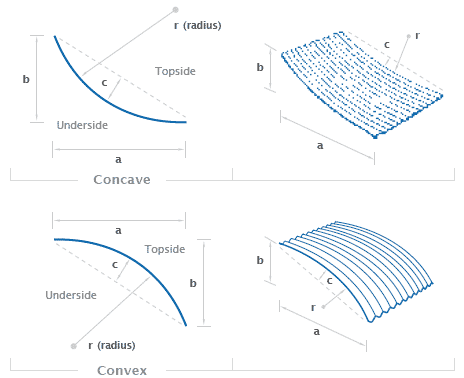
Yes, these terms confuse too many of us. Much of it because it relates to the viewers orientation.
Guy Manning
~~~~~~~~~~~~~~~~~~~~~~~~~~~~~~~~~~~~~~~~~~~~~~~~~~~~~~~~~~~~
[GH] Guy,
True. That was one of Bob Stouffer's points in his message, above. Whether a line or a path is described as CONVEX or CONCAVE, depends upon the viewers orientation. We must have a frame of reference.
In your diagrams, the reference is to the radius of an imaginary arc. That radius, to me, represents the fly rod at multiple angular positions during the casting arc. The dot at the end representing the angler.
Gordy
~~~~~~~~~~~~~~~~~~~~~~~~~~~~~~~~~~~~~~~~~~~~~~~~~~~~~~~~~~~~
To be removed from this mailing list, please click here to unsubscribe