|
Walter & Group...
[GH] Aitor Coteron uses the bead chain demonstration to indicate that a curve layout can be achieved with an overpowered curve cast made in the horizontal rod plane even if counterflex and rebound are eliminated provided that all the energy has not dissipated when the loop has unfurled.
He calls attention to the difference between this curve and the one seen in his prior video. In his first video, he shows that the line wave is produced by the reach mend.... not accentuated counterflex or rebound.
To allow for easier comparison, I'll include the original video here : http://vimeo.com/21349829
|
Hi Gordy,
There is a fundamental difference between Guy's explanation and the effect observed in the overpowered curve cast video whose link I sent you:
In the video the fly lands exactly in line with the direction of the rod leg of the loop.
Another type of curve is that which results of the tendency (due to momentum conservation) of the line tip to follow the path of a tank chain, so to speak. In this case the fly lands way to the side of the straight line defined by the rod leg of the loop.
Here we can see both effects:
You can use it with the group as you prefer.
Thanks,
Aitor
~~~~~~~~~~~~~~~~~~~~~~~~~~~~~~~~~~~~~~~~~~~~~~~~~~~~~~~~~~~~~~~~~~~~~~~~~~~~~~
[GH] From Mark Surtees :
Hi Gordy
I remember that thread, it became quite heated… J
There were many who did not, and probably still would not, agree with Guy on this and insisted that the question mark shape that we often get in the layout of an overpowered curve is indication of a mend. As Guy points out, and I’m sure Aitor agrees, it isn’t and the wave that causes it is very easy to see with the naked eye in casts unadulterated with hauls or pullbacks or mends. It commonly appears in a tuck cast too as a raised hump in the line until gravity takes over.
" [GH] When performing Task 5, (Over powered curve casts) however, let's assume the candidate is using a well designed line/leader system with a light yarn fly and a floating line. In that instance, do you think the "kick-over" is simply produced by an overpowered cast, high line speed, and an early "hard stop" ?"
Yes I do…, for a fairly standard exam set up the cast is helped if the plane in which we make it is tilted slightly upward during the FC . I remember very clearly that I initially failed to make this relatively minor adjustment during my MCCI test and nearly ballsed the whole thing up.
Selecting the right line and leader set up that won’t pull out the mends but kicks over for the OP curves is an interesting exercise in compromise… J
Mark
~~~~~~~~~~~~~~~~~~~~~~~~~~~~~~~~~~~~~~~~~~~~~~~~~~~~~~~~~~~~~~~~~~~~~~~~~~~~
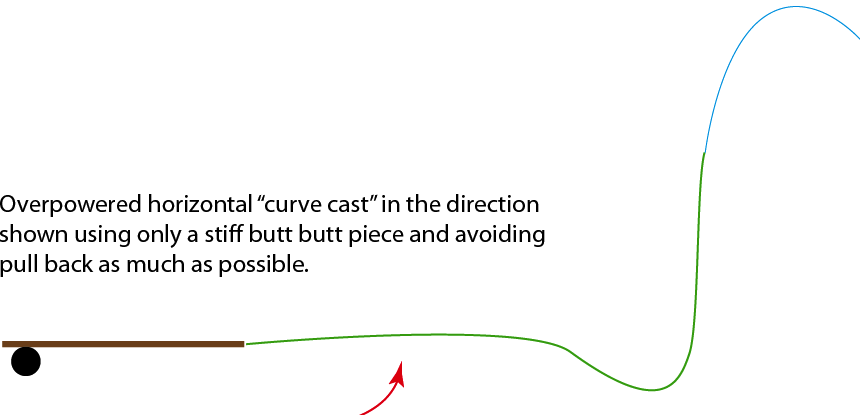
[GH] Ally Gowans comments ( I have placed his diagram in an attachment in addition to the message body )
:
Hi Gordy,
Guy’s observations I believe are correct but since I don’t know what a “counter wave” I have doubts about the terminology. The deviation from the straight line is caused by the high speed of the unfurling fly line and its momentum carrying it from one side of the rod leg to the opposite, the rod leg being supported by the rod tip acts like a pivot to allow this turning of the tip.
To convince myself I took the butt piece from a 2pc 9ft rod and attached the reel and about 30ft of line from the end of the section. I laid the line out on the lawn and made several overpowered horizontal casts trying not to induce any pull back and assuming that the very stiff rod would help avoid tip counter-flex. The fly line had tapered leader and a dry yarn “fly” which probably explains why it seldom straightened properly. A typical result is shown in the sketch and that is probably what a fairly unfettered “curve cast” produces although with a fly that had a tiny amount of mass (or even a wet piece of yarn) I believe that the result would have been better.
Best regards,
Ally Gowans
~~~~~~~~~~~~~~~~~~~~~~~~~~~~~~~~~~~~~~~~~~~~~~~~~~~~~~~~~~~~~~~~~~~~~~~~~~~~~~~~~~~~~~~