|
Walter & Group...
[GH] Pete Greenan comes forth with another analogy re pin-point accuracy as he makes a comparison between navigation markers and the 1" black dot Rene Hesse suggested placing on the target cones :
Rene,
Marine intracoastal waterway signs have a florescent square or triangle on them to distinguish them, but it also helps night travelers to see them clearly at a great distance. This is the same idea you have about the dot on the cone; smaller, more focused target = better accuracy.
Pete Greenan
~~~~~~~~~~~~~~~~~~~~~~~~~~~~~~~~~~~~~~~~~~~~~~~~~~~~~~~~~~~~~~~~~~~~
[GH] Also: I couldn't help thinking of the cross-hairs in a sniper's scope when Rene Hesse mentioned Dave Diaz's teaching about the cat sizing up its prey by focussing in vertical and horizontal planes back and forth before pouncing. I've read that big predatory cats such as leopards do that.
I have noted, when testing, that candidates do a bit better when casting to cones rather than to rings flat on the grass or water. I think it may have to do with the vertical visual component.
Many tricks for fly casting accuracy out there !!
~~~~~~~~~~~~~~~~~~~~~~~~~~~~~~~~~~~~~~~~~~~~~~~~~~~~~~~~~~~~~~~~~~~
[GH] From Walter Simbirski :
Hi Gordy,
I'm not sure if my point was clear.
Using a horizontal casting plane when dialing in distance virtually eliminates the need for depth
perception. In addition to maximizing the triangulation affect a horizontal plane with an open stance
also means that you are less likely to lose sight of your fly because you can see the entire flight path
of the fly. If you do need to hover the fly over the target a parachute cast is an excellent way to do this.
My perception is that if a candidate were to line up their distance by casting side arm with an open
stance it would be frowned upon by a significant percentage of examiners.
Perhaps I'm wrong in that perception but it seems to me that a good question to ask a candidate is,
"Why is a vertical casting stroke with closed stance preferred when making the presentation cast in
the accuracy task?"
Cheers
Walter
~~~~~~~~~~~~~~~~~~~~~~~~~~~~~~~~~~~~~~~~~~~~~~~~~~~~~~~~~~~~~~~~~~
[GH] Walter,
I do understand your point. That is one of the many reasons I use an off vertical to off horizontal rod plane when fishing. For me, casting in the vertical plane is far less efficient.... for some others it works fine.
HOWEVER...
If I were the candidate and you asked me that questions, here is how I'd answer :-
"For the close targets, I use a vertical rod plane (casting plane) for two reasons:
1. I'm much less likely to make a right to left side error. I use a trajectory directly back and up from a point just above the target for my back cast and a forward cast 180 degrees in line with it. This steep trajectory helps me judge distance. The targets being close helps me see my fly as I hover which also helps me determine distance.
2. I've been told that the examiners want me to cast as I would teach. That means using a style which would allow my students to see my loops on both back cast and forward cast. A horizontal casting plane won't do that nearly as well. A vertical casting plane also allows my students to more easily see my changes of trajectory as I go from a very close target to one at greater distance and vice versa.
#. For the distance target, I need more stroke length and increased casting arc. To achieve that, I use an open stance and off vertical casting plane. This casting plane also allows me to use the principle of the accuracy triangle to help judge my distance.
#, When fishing, I would probably use a more horizontal casting plane, depending upon the weather and other conditions. This happens to be my default style."
~~~~~~~~~~~~~~~~~~~~~~~~~~~~~~~~~~~~~~~~~~~~~~~~~~~~~~~~~~~~~~~~~~~~
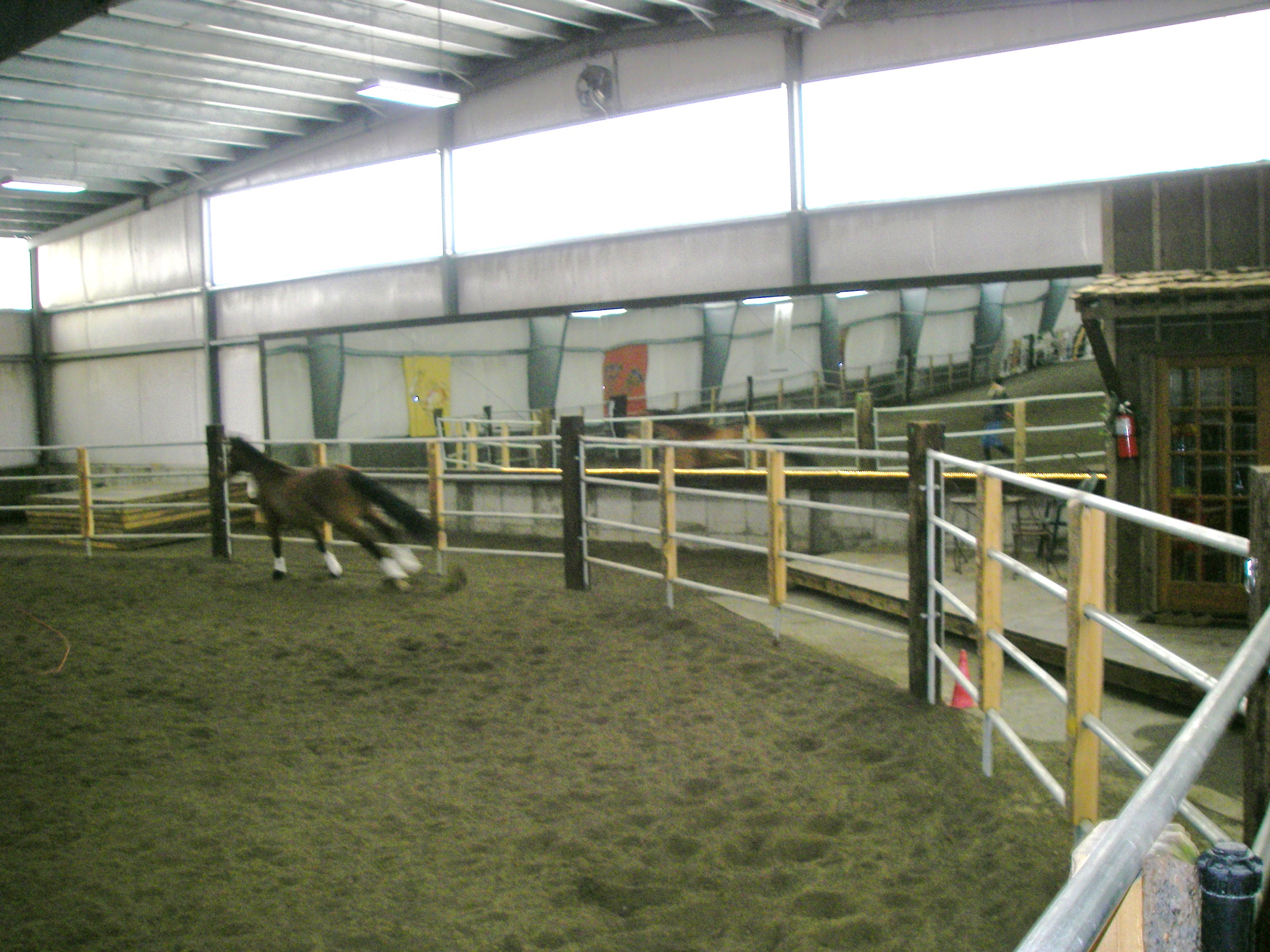
[GH] Casting mirrors ! Interesting suggestion from Mark Milkovitch (His photo is attached) :
Gordy,
Task #11 reminded me of something I wanted to share with the group. Molly Semenik had a reflective picture window so she could watch her back cast without turning her head to the rear. There’s a good alternative which should be available to most in the study group: equestrian arenas where there are riders who participate in Dressage. Dressage scores the elegance and precision of horse/rider movements so one wall of the arena is typically covered with a large mirror so the rider can see him or herself while riding. The mirrors are large enough to work well for fly casters as well. Some of these arenas rent time (look under Horse Training & Riding Instruction in the yellow pages). Other arenas are built and used by an individual (the local equine veterinarians, tack shop, farm and ranch store and horseshoeing professionals will know about them). There will be differences among arenas: some have higher quality mirrors than others, some are better lit. If you don’t like the first one you visit, it pays to keep looking.
Mark Milkovich
~~~~~~~~~~~~~~~~~~~~~~~~~~~~~~~~~~~~~~~~~~~~~~~~~~~~~~~~~~~~~~~~~~~~~
[GH] Mark,
One advantage of the "casting mirrors" is that this system is in real time whereas video is not.
~~~~~~~~~~~~~~~~~~~~~~~~~~~~~~~~~~~~~~~~~~~~~~~~~~~~~~~~~~~~~~~~~~~~~
|
Attachment:
IMGP5089.JPG
Description: JPEG image