Walter & Group....
[GH] As teachers of fly casting we are all educators. In my humble opinion, Ally is at the top. Over the years I (and we) have learned a great deal from him.
Take your time to follow this string carefully..... it is a lesson in education.
~~~~~~~~~~~~~~~~~~~~~~~~~~~~~~~~~~~~~~~~~~~~~~~~~~~~~~~~~~~~~~~~~~~~~~~~~~~~~~~~~~~~~~~
Hi Gordy,
The following is my first response to the exercise. I will forward my own answers together with Paul’s and with further explanations and comments shortly. There are a lot of things arising from this that could be expanded upon.
It’s said that most questions are asked for a couple of reasons; either to find out what someone knows or to find out what they don’t know. Such questions are generally asked during tests.
However there is another very important reason to ask questions which is to invite reason to be employed by students to figure things out for themselves and asking this type of question is a valuable teaching method. If you can get your students to figure things out for themselves you will have become a great teacher.
My “daft” questions are intended to fall into the latter category. Some observations:
· It is clear that some did not always read them correctly (or maybe I didn’t ask them correctly?)
· Some of you already knew some of the answers which is great.
· Some had to think hard and maybe some thoughts are still rolling around in heads. Hopefully they reached the right conclusions and if not hopefully they will do so once the exercise is complete.
Some people changed their original answers and those that did were spot on at the second attempt! Now that’s what I call learning – it’s a very wise man that has afterthoughts first!
All of the questions were posed to make the group focus more closely on the fly line simply because many of us put far too much emphasis on the rod and do not consider the line nearly enough. Rods are dispensable but you can’t make a cast without a line.
Hopefully this exercise will increase appreciation of the importance of line location and mass distribution during casting.
First a summary of the answers that I received from Gordy (apart from our friend Paul Arden’s contribution which I’m going to list together with my own answers in a later message). At that time I will add some further explanations. Compare the answers with the questions and even if you did not submit your own think about which you consider is best in each case. I have lettered the answers so that you may refer to them. There are some very good answers!
1.) Are any two casts identical?
a) Only imaginary ones.
b) No. similar yes, identical no.
c) No there are too many variables.
d) Can be, If you are perfect in every way , but I have not met that person yet! Probably would not like him or her. ;o)
e) No
f) No, too many variables.
g) snowflake.
2.) Does it matter where a loop is first observed?
a) No. However, our goal as instructors, fishermen and casters is to come as close as possible to that unattainable goal given nearly identical circumstances.
b) Yes because this will determine the shape of the loop
c) Where it is observed ? No, not for any practical purposes.
d) No
e) No, it doesn't matter when the loop is "first observed". (See Note 1 at the end of the list which is part of the answer given here)
f) Yes because is gives direction to the cast. As you say below launch direction.
g) Depends on whether you are talking to a beginner or a more advanced caster . For a more advanced caster knowing this they may be able to adjust their casting to affect the loop formation . For a beginner no.
h) If you mean when it is formed then yes.
i) if you care it can.
3.) How would you recognise loop formation?
a) If you could pick it precisely, arguably, it would begin when the line passes the rod tip.
b) The product - the unrolling loop. If a fault such as a tailing loop, I could work on a correction (loop forms too early).
c) The point when the fly-line starts overtaking the rod-tip
d) I would use the definition, "When the fly line overtakes the rod tip".
e) When the fly leg is formed.
f) A loop forms when the fly leg has rolled over itself to form the rod leg. Some people say this occurs at RSP while others say at maximum counter flex. From a practical standpoint I like Soon Lees description of the STOP as deviation from SLP up to eventual RSP or rod holding position as a determinant of the size of the loop face.
g) Difficult to see the initial point but it is when the line overtakes the rod tip.
h) with my senses; mostly by sight.
4.) And if it could be observed how would it help you to teach me?
a) Generating a proto-loop, one which is really a just a wave propagating down a vertical line, is a very good way to encourage a stop and demonstrate the appropriate timing of a pause in side to side casting in front of a caster. Observing the exact point of formation in normal instruction is not terribly useful teaching wise though.
b) Generally an acceleration fault - "smooth acceleration to a stop"
c) I don’t think it could be observed
d) I think that the actual point where the line overtakes the tip would be useful in analysing a video, frame by frame, with a distance casters like Paul or Lasse. But I think for the vast majority of casters determining that exact point would not be critical or all that helpful.
e) Helps by watching the line with relationship to the rod movements to help initiate the fly leg where you want your fly to go (The Launch Direction). Trajectory
f) Deviation from SLP and eventual rod holding position are events you can easily observe, and we can easily teach.
g) Point of loop formation and loop geometry would indicate how the caster has moved the rod tip through the casting stroke. Use this to make any necessary corrective changes to the casting stroke.
h) how much time do we have.
5.) Defining “useful energy” as that which is the line requires to extend correctly. When does the rod cease to provide “useful energy” to the line?
With this definition, at MCF…this would be the case if there was too much or too little “useful energy” too.
a) As it straightens and the line continues without acceleration.
b) The moment the rod-tip stops accelerating and begins decelerating
c) It ceases to provide useful energy when its energy exceeds the requirements for the cast to serve its purpose, or at some point during the tip's departure from relative SLP, or when the tip speed slows relative to line speed ( not counting its effect when hauling).
d) In my opinion the rod is always providing useful energy to the line as long as the line stays connected to the rod. Even after SLP, MCF, and even after the line hits the water. We call it mending. Energy is provided by the rod from the very beginning to the very end of the drift in my opinion. Even when we are feeding line to the system to prolong the drift!
e) New answer ; the rod ceases to provide useful energy to the fly line when the acceleration vector in the direction of the line launch is less than the following fly line.
f) Prior to loop formation, at any time when there is no component of rod tip acceleration in the target direction (the line will still extend but not correctly if that is defined as traveling in the target direction). And also after loop formation. You can’t push a piece of string!
g) could be said: when it ceases all movement. are we making a basic cast, are we mending, or just moving thru the rings to get ready for a roll cast? could be said: somewhere around RSP(s).
6.) Is it possible for the line and rod tip to travel together without useful energy interchange?
a) Using the definition above, yes definitely.
b) Yes. If acceleration were no longer being applied.
c) No - the fly-rod must always be accelerating and hence storing more energy if the fly-line is to remain under control
d) Absolutely. The rod tip and line travel together during "windshield wiper" casting motions as well as many others which are often not in the least useful.
e) Not in my opinion there is always exchange being made between line and rod. I do not think I can cast that good or bad to make this happen as long as they stay connected!
f) When we move the rod tip and line together at a constant velocity. when we drag a horizontal rod with the line attached. in fact in all situations where the rod tip moves without an appreciable bend in the rod.
g) If the rod axis and line are in alignment and moved at constant velocity then yes.
h) yes, marriage has many facets
7.) If the mass of a fly line is considered to concentrated at a single point and the rest of the line is considered weightless does this help to illustrate the location of the line launch direction?
a. Sorry Ally….lost me here…what is the “location of the line launch direction” ?
b. You can consider that the rod-tip feels the line at a single point. The launch could be considered as "slinging" as you may do with a lacrosse stick and ball.
c. Yes. And as Gordy mentioned earlier, I think distance casters are acutely aware of this. I'm guessing that the elevation of this mass as well as line straightness plays a big part in whether they launch or re-adjust with another backcast.
d. No this doesn’t help
e. That question is too difficult for me. I would have to go out and try different lines and I just don't have time right now. I think much of this depends on the length of line being both carried and cast.
f. We have stated that heavy line which has greater mass will turn over lighter line. So the direction of the lighter line will be dictated by the direction of the heavy line on the cast. The lighter line will follow the launch direction of the heavier line.
g. In a spinning or bait-casting system the linear acceleration of the mass/weight determines the line of launch for that mass, so yes it will help in determining line launch of an accelerated fly line.
h. The launch direction (I assume you mean elevation, i.e. direction as viewed in the vertical plane) is the rod tip direction at launch point.
i. wouldn't "the rest of the line" be considered as part of the line's mass?
8.) If the line is now considered to be a chain of different link sizes to replicate the taper what change does that make to your consideration?
a) None I think…I don’t understand “a location of line launch direction” but the distribution of mass through the line is not going to have a significant effect on the direction that we choose to launch it. Mass distribution will effect other things, I suppose a caster might alter trajectory to take these effects into consideration.
b) None. The rod tip / line "connection" is all that we can feel. the taper speaks to line behavior after launch. It could, however, be a tool for organizing the line prior to launch.
c) Yes this is helpful because it is possible to establish the approximate total mass on the fly leg side of the loop and this can help in predicting how the line will perform e.g.s fast/slow turnover and long/short loft
d) In the case of a line launch that breaks the 180 degree rule by too far it does and can result in either tailing loops or huge ineffectual ones or swinging, or hooking in the other plane.
e) None
f) Because the chain has a significant mass attached to it, it may affect the trajectory of the chain launch depending on the size of the acceleration away from the intended path and the amount/ mass of trailing chain.
g) Mass distribution in the line results in loop formation. Each ‘link’ is influenced by the preceding link and also influences following links.
h) gonna' scare most fish.
9.) Does the line launch direction indicate where useful energisation of the line ceased?
a) No.
b) No. An inflexible rod requires a near impossible compound movement to gain a tip travel that does not yield a non-loop.
c) Yes
d) No
e) No see no. 7. A line acceleration away from the intended path still contributes to the fly leg acceleration in the intended path depending on the amount of acceleration away from it and the moving mass/length of line that is being accelerated.
f) Energisation of the line in the launch direction ceases at loop formation.
g) see answer to 5.)
10.) It is better but is it absolutely necessary to have a rod that bends?
a. No.
b. It is possible to cast with a rod that doesn’t bend
c. For me it is ;>). I made a 4 foot rod from a hollow metal broomstick, a funnel to guide line into its hollow center through a hole I drilled in it, and outfitted it with a reel spooled with a 12 wt line last year to try out. I was able to cast the head all the way straight, but came to within a few feet per second of throwing my hauling arm out of its socket. I will never try that again, and do not recommend anybody else to try it either.
d. No but I prefer one the bends in all the right ways for me!
e. For efficient casting of a flyline a rod that bends facilitate the conversion of rotational acceleration/torque to linear acceleration of a flyline as the rod can produce approximate SLP.
f. No, you can cast with a broomstick, unpleasant but possible. You can also cast without a rod.
g. if you're a rod salesman, yes.
11.)
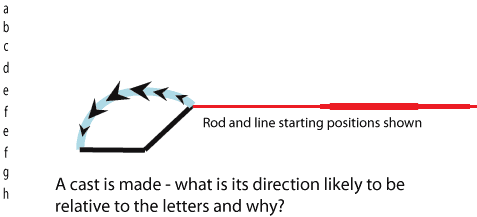
i. My guess is that that is going to head off somewhere around e..wide loop. Power is being applied past the angle at which the rod bend will displace towards the tip due to the change of angle with the line…could be a “stopless” cast this one.
ii. If you think of the line as linked beads, each bead cast in the line is cast at a different point. The direction of this cast will cascade from h to c (or thereabouts). Interesting that the last bead to arrive (c) is related to the first movement of the casting stroke and the first bead to arrive (h) is related to the last piece of movement of the casting stroke. (2nd answer)
iii. Top f – assuming this is a shooting head with a long overhang
iv. Bottom e – assuming that start of back taper is at rod tip and that fourth arrow from the right indicates maximum rod-tip velocity
v. I think the line will wind up in the vicinity of the "F" position. The reason is that the line is already fairly close to the maximum height the rod tip will travel. As the rotation begins, the running line will begin lifting at the tip and work to the end of the line. But due to the increased mass and inertia of the head, as well as its distance from the tip which reduces the "pull angle" on it, it will start forward but it's upward trajectory will not be so great. Then as the rod acceleration gets into full swing, the pull angle lowers again, pulling down on the leading section of head.
vi. That portion of rod rotation in a downward direction will have little effect on the trajectory of the head itself, as it not contributing to useful line speed and the mass of the running line following it downward is not sufficient to drag the head down with it.
vii. Between C & E in my opinion for launch direction, and all points in between C and F for wide loop formation and line path to follow. . with the heavier line pulling the lighter line through the cast being made absence of a stop (Convex path). I could even see the fly leg spiking up, as high as B or C depending on the line set up. This cast would lay out depending on the location of the heavier line mass in the line, when the cast is made. That heavier line mass will dictate Launch direction of the line and the overall line path based on rod tip path shown above. ;o)
viii. Most likely between d and e as that seems to be the point where the rod tip path deviates from the approximate straight line acceleration path. The line looks like a shooting head or one where there is a lot of overhang which cant influence the trajectory of the line momentum.
ix. Somewhere around d to upper e. Loop formation will occur when the rod tip travels though that direction. Rod tip velocity and acceleration components in that direction appear to reduce as the rod tip travel continues.
x. over-hang too great. collapsed cast. maybe none of the above.
Note 1:
It doesn't matter from a teaching standpoint because the events preceding loop formation will dictate where it starts. These events encompass more time and are much more easily seen by an observer than the actual event itself. In fact, looking for it may distract the observer from other important aspects of the cast.
The shape of the loop as it unrolls can also be easily seen by an instructor (and caster) and gives a reliable indicator as to where the loop began forming as well as the events preceding it. The unrolling loop will also be a reliable indicator of what events happened after the loop formed.
The shape of the loop as it unrolls can also be easily seen by an instructor (and caster) and gives a reliable indicator as to where the loop began forming as well as the events preceding it. The unrolling loop will also be a reliable indicator of what events happened after the loop formed.
Best wishes,
Ally Gowans
See my web sites http://www.letsflyfish.com and http://www.flyfish-scotland.com