Walter & Group....
[GH] I'm back from Belize. While there, I spent a thoroughly enjoyable time coaching aspiring native CCI candidates who were all local salt water fly fishing guides. Delightful, hard working folks.
I was ably assisted by Lori Ann Murphy of REEL WOMEN who, today, joins our Master Study Group as our 191st member.
Liam Duffy sends an interesting question from Ireland :
"Where did the word "QUIZ" originate ? seeing as you use it regularly if you'r not sure throw it out to the class."
Liam Duffy
Now for answers to Ally Gowan's Quiz. This has been an intriguing exercise ! Several who answered wrote back to change some answers for their initial ones. Truly a brain teaser. I'll be more than interested to see Ally's answers .
>From Mark Surtees :
1.) Are any two casts identical?
Only imaginary ones.
2.) Does it matter where a loop is first observed?
Where it is observed ? No, not for any practical purposes.
3.) How would you recognise loop formation?
If you could pick it precisely, arguably, it would begin when the line passes the rod tip.
4.) and if it could be observed how would it help you to teach me?
Generating a proto-loop, one which is really a just a wave propagating down a vertical line, is a very good way to encourage a stop and demonstrate the appropriate timing of a pause in side to side casting in front of a caster. Observing the exact point of formation in normal instruction is not terribly useful teaching wise though..
5.) Defining “useful energy” as that which is the line requires to extend correctly. When does the rod cease to provide “useful energy” to the line?
With this definition, at MCF…this would be the case if there was too much or too little “useful energy” too.
6.) Is it possible for the line and rod tip to travel together without useful energy interchange?
Using the definition above, yes definitely.
7.) If the mass of a fly line is considered to concentrated at a single point and the rest of the line is considered weightless does this help to illustrate the location of the line launch direction?
Sorry Ally….lost me here…what is the “location of the line launch direction” ?
8.) If the line is now considered to be a chain of different link sizes to replicate the taper what change does that make to your consideration?
None I think…I don’t understand “a location of line launch direction” but the distribution of mass through the line is not going to have a significant effect on the direction that we choose to launch it. Mass distribution will effect other things, I suppose a caster might alter trajectory to take these effects into consideration.
9.) Does the line launch direction indicate where useful energisation of the line ceased?
No.
10.) It is better but is it absolutely necessary to have a rod that bends?
No.
10.)
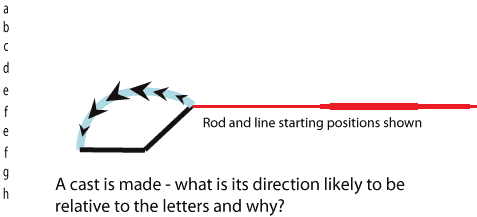
My guess is that that is going to head off somewhere around e..wide loop. Power is being applied past the angle at which the rod bend will displace towards the tip due to the change of angle with the line…could be a “stopless” cast this one.
Mark
~~~~~~~~~~~~~~~~~~~~~~~~~~~~~~~~~~~~~~~~~~~~~~~~~~~~~~~~~~~~~~~~~~~~~~~~~~~~~~~~~~~~~~~~~~~~~
[GH] From Bob Stouffer :
[GH] A practical brain teaser !
Ten questions from Ally Gowans.
Let's see your answers to his questions. Ally will "correct them" and I'll send the results when I return from Belize next week :-
Hi Gordy,
Some deep thinkers out there. So much fascination with what the rod does, it’s been often said that we cast the line not the rod and considering the rod in isolation is not helpful. So I ask a few “daft” questions?
1.) Are any two casts identical? No. similar yes, identical no.
2.) Does it matter where a loop is first observed? No
3.) How would you recognise loop formation? The product - the unrolling loop. If a fault such as a tailing loop, I could work on a correction (loop forms too early).
4.) and if it could be observed how would it help you to teach me? If the loop formation were too early. Generally an acceleration fault - "smooth acceleration to a stop"
5.) Defining “useful energy” as that which is the line requires to extend correctly. When does the rod cease to provide “useful energy” to the line? As it straightens and the line continues without acceleration.
6.) Is it possible for the line and rod tip to travel together without useful energy interchange? Yes. If acceleration were no longer being applied.
7.) If the mass of a fly line is considered to concentrated at a single point and the rest of the line is considered weightless does this help to illustrate the location of the line launch direction? You can consider that the rod-tip feels the line at a single point. The launch could be considered as "slinging" as you may do with a lacrosse stick and ball.
7.) If the line is now considered to be a chain of different link sizes to replicate the taper what change does that make to your consideration? None. The rod tip / line "connection" is all that we can feel. the taper speaks to line behavior after launch. It could, however, be a tool for organizing the line prior to launch.
8.) Does the line launch direction indicate where useful energisation of the line ceased? Yes
9.) It is better but is it absolutely necessary to have a rod that bends? No. An inflexible rod requires a near impossible compound movement to gain a tip travel that does not yield a non-loop..
10.)
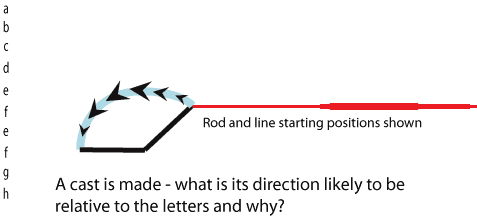
The line is asked to reorganize during the entire stroke, but the last part of the acceleration and stop is vectored down. The very wide loop will travel toward G. .
Best wishes,
Ally Gowans
~~~~~~~~~~~~~~~~~~~~~~~~~~~~~~~~~~~~~~~~~~~~~~~~~~~~~~~~~~~~~~~~~~~~~~~~~~~~~~~~
[GH] Bob Stouffer adds this message :
Thinking about question 7 and 10. I want to modify my answer of the last question. If you think of the line as linked beads, each bead cast in the line is cast at a different point. The direction of this cast will cascade from h to c (or thereabouts). Interesting that the last bead to arrive (c) is related to the first movement of the casting stroke and the first bead to arrive (h) is related to the last piece of movement of the casting stroke.
Bob Stouffer
~~~~~~~~~~~~~~~~~~~~~~~~~~~~~~~~~~~~~~~~~~~~~~~~~~~~~~~~~~~~~~~~~~~~~~~~~~~~~~~~~~~~
[GH] John Symonds weighs in :
Hi Gordy,
Here are my thoughts on the quiz. I hope you had a good time down south. 1.) Are any two casts identical?
No. However, our goal as instructors, fishermen and casters is to come as close as possible to that unattainable goal given nearly identical circumstances.
2.) Does it matter where a loop is first observed?
Yes. The start of its formation would ideally have its fly leg situated in a direct line with the center of mass of the trailing line. The closer the fly leg approximates a straight line throughout its entire length, the move efficient the cast.
3.) How would you recognise loop formation?
I would use the definition, "When the fly line overtakes the rod tip". (Thanks, Gordy)
4.) and if it could be observed how would it help you to teach me?
It would provide information on casting arc size, trajectory, pause timing, stroke length vis a vis rod bend, line tension or lack of it and so on.
5.) Defining “useful energy” as that which is the line requires to extend correctly. When does the rod cease to provide “useful energy” to the line?
It ceases to provide usefull engergy when its energy exceeds the requirements for the cast to serve its purpose, or at some point during the tip's departure from relative SLP, or when the tip speed slows relative to line speed ( not counting its effect when hauling).
6.) Is it possible for the line and rod tip to travel together without useful energy interchange?
Absolutely. The rod tip and line travel together during "windshield wiper" casting motions as well as many others which are often not in the least useful.
7.) If the mass of a fly line is considered to concentrated at a single point and the rest of the line is considered weightless does this help to illustrate the location of the line launch direction?
Yes. And as Gordy mentioned earlier, I think distance casters are acutely aware of this. I'm guessing that the elevation of this mass as well as line straightness plays a big part in whether they launch or re-adjust with another backcast.
7.) If the line is now considered to be a chain of different link sizes to replicate the taper what change does that make to your consideration?
That question is too difficult for me. I would have to go out and try different lines and I just don't have time right now. I think much of this depends on the length of line being both carried and cast.
8.) Does the line launch direction indicate where useful energisation of the line ceased?
In the case of a line launch that breaks the 180 degree rule by too far it does and can result in either tailing loops or huge ineffectual ones or swinging, or hooking in the other plane.
9.) It is better but is it absolutely necessary to have a rod that bends?
For me it is ;>). I made a 4 foot rod from a hollow metal broomstick, a funnel to guide line into its hollow center through a hole I drilled in it, and outfitted it with a reel spooled with a 12 wt line last year to try out. I was able to cast the head all the way straight, but came to within a few feet per second of throwing my hauling arm out of its socket. I will never try that again, and do not recommend anybody else to try it either.
10)
I think the line will wind up in the vicinity of the "F" position. The reason is that the line is already fairly close to the maximum height the rod tip will travel. As the rotation begins, the running line will begin lifting at the tip and work to the end of the line. But due to the increased mass and inertia of the head,,as well as its distance from the tip which reduces the "pull angle" on it, it will start forward but it's upward trajectory will not be so great. Then as the rod acceleration gets into full swing, the pull angle lowers again, pulling down on the leading section of head.
That portion of rod rotation in a downward direction will have little effect on the trajectory of the head itself, as it not contributing to useful line speed and the mass of the running line following it downward is not sufficient to drag the head down with it.
Cheers,
Jim
~~~~~~~~~~~~~~~~~~~~~~~~~~~~~~~~~~~~~~~~~~~~~~~~~~~~~~~~~~~~~~~~~~~~~~~~~~~~~~~~~~~~~~~
[GH] Answers from Jim Chestnut :
Hi Gordy,
Here are my thoughts on the quiz. I hope you had a good time down south. 1.) Are any two casts identical?
No. However, our goal as instructors, fishermen and casters is to come as close as possible to that unattainable goal given nearly identical circumstances.
2.) Does it matter where a loop is first observed?
"No, it doesn't matter when the loop is "first observed".
It doesn't matter from a teaching standpoint because the events preceeding loop formation will dictate where it starts. These events encompass more time and are much more easily seen by an observer than the actual event itself. In fact, looking for it may distract the observer from other important aspects of the cast.
The shape of the loop as it unrolls can also be easily seen by an instructor (and caster) and gives a reliable indicator as to where the loop began forming as well as the events preceeding it. The unrolling loop will also be a reliable indicator of what events happened after the loop formed.
3.) How would you recognise loop formation?
I would use the definition, "When the fly line overtakes the rod tip". (Thanks, Gordy)
4.) and if it could be observed how would it help you to teach me?
I think that the actual point where the line overtakes the tip would be useful in analysing a video, frame by frame, with a distance casters like Paul or Lasse. But I think for the vast majority of casters determining that exact point would not be critical or all that helpful.
5.) Defining “useful energy” as that which is the line requires to extend correctly. When does the rod cease to provide “useful energy” to the line?
It ceases to provide useful energy when its energy exceeds the requirements for the cast to serve its purpose, or at some point during the tip's departure from relative SLP, or when the tip speed slows relative to line speed ( not counting its effect when hauling).
6.) Is it possible for the line and rod tip to travel together without useful energy interchange?
Absolutely. The rod tip and line travel together during "windshield wiper" casting motions as well as many others which are often not in the least useful.
7.) If the mass of a fly line is considered to concentrated at a single point and the rest of the line is considered weightless does this help to illustrate the location of the line launch direction?
Yes. And as Gordy mentioned earlier, I think distance casters are acutely aware of this. I'm guessing that the elevation of this mass as well as line straightness plays a big part in whether they launch or re-adjust with another backcast.
7.) If the line is now considered to be a chain of different link sizes to replicate the taper what change does that make to your consideration?
That question is too difficult for me. I would have to go out and try different lines and I just don't have time right now. I think much of this depends on the length of line being both carried and cast.
8.) Does the line launch direction indicate where useful energisation of the line ceased?
In the case of a line launch that breaks the 180 degree rule by too far it does and can result in either tailing loops or huge ineffectual ones or swinging, or hooking in the other plane.
9.) It is better but is it absolutely necessary to have a rod that bends?
For me it is ;>). I made a 4 foot rod from a hollow metal broomstick, a funnel to guide line into its hollow center through a hole I drilled in it, and outfitted it with a reel spooled with a 12 wt line last year to try out. I was able to cast the head all the way straight, but came to within a few feet per second of throwing my hauling arm out of its socket. I will never try that again, and do not recommend anybody else to try it either.
10)
I think the line will wind up in the vicinity of the "F" position. The reason is that the line is already fairly close to the maximum height the rod tip will travel. As the rotation begins, the running line will begin lifting at the tip and work to the end of the line. But due to the increased mass and inertia of the head,,as well as its distance from the tip which reduces the "pull angle" on it, it will start forward but it's upward trajectory will not be so great. Then as the rod acceleration gets into full swing, the pull angle lowers again, pulling down on the leading section of head.
That portion of rod rotation in a downward direction will have little effect on the trajectory of the head itself, as it not contributing to usefull line speed and the mass of the running line following it downward is not sufficient to drag the head down with it.
Cheers,
Jim
~~~~~~~~~~~~~~~~~~~~~~~~~~~~~~~~~~~~~~~~~~~~~~~~~~~~~~~~~~~~~~~~~~~~~~~~~~~~~~~~~~~~~~~
[GH] From Bill Keister :
Gordy,
Some deep thinkers out there. So much fascination with what the rod does, it’s been often said that we cast the line not the rod and considering the rod in isolation is not helpful. So I ask a few “daft” questions?
1.) Are any two casts identical?
Similar yes, identical no.
2.) Does it matter where a loop is first observed?
Yes.
3.) How would you recognise loop formation?
Rod tips can pull lines around an arc the looks like a loop, however, I don't think the loop forms until the tension in the line is derived from the kinetic energy being given up by the oncoming fly line instead of from rod movement and/or haul.
4.) and if it could be observed how would it help you to teach me?
My definition is so esoteric that I don't think it would help.
5.) Defining “useful energy” as that which is the line requires to extend correctly. When does the rod cease to provide “useful energy” to the line?
At RSP.
6.) Is it possible for the line and rod tip to travel together without useful energy interchange?
Yes. And, it could be moving in an arc departing from the trajectory of the oncoming line as long as it transmitted on enough energy to energize only the line in that arc.
7.) If the mass of a fly line is considered to concentrated at a single point and the rest of the line is considered weightless does this help to illustrate the location of the line launch direction?
Yes. It illustrates that the force in the direction of line launch is considerably greater than the forces that can be transmitted which are perpendicular to the direction of line launch.
7.) If the line is now considered to be a chain of different link sizes to replicate the taper what change does that make to your consideration?
Yes, the intermediate masses effect the direction of the force felt at the end of the chain by reducing the vertical (perpendicular) component of the force.
8.) Does the line launch direction indicate where useful energisation of the line ceased?
No. Snap-T and Circle-C spey casting moves illustrated energizing of fly lines in directions other than line launch. This process is applicable to overhead casts to a lessor extent.
9.) It is better but is it absolutely necessary to have a rod that bends?
It is not absolutely necessary. But, I think you give up a great deal of control and effiency without the bend.
10.)
I think the line would move toward the upper e/f. Without going into tip deflection which would favor this direction lets look a what force a point at the left hand edge of the fly line head would experience. Movements of the rod tip vertically up and down will have very little effect on the vertical movement of the fly line head. If the rnning line between the rod tip and the beginning of the fly line head was ridged the primary force would be in a horizontal plane and a significantly smaller force would be experience in a vertical dircetion. Because the running line bends the vertical component would be further reduced. The ultimate path of the fly line head is determined more by where it starts from then how it is pulled. What is effected by the position of the rod tip at the completion of the cast is the size of the loop.
Bill
~~~~~~~~~~~~~~~~~~~~~~~~~~~~~~~~~~~~~~~~~~~~~~~~~~~~~~~~~~~~~~~~~~~~~~~~~~~~~~~~~~~~~~~~~~~~~~~~~~~~~~~~~