Walter & Group...
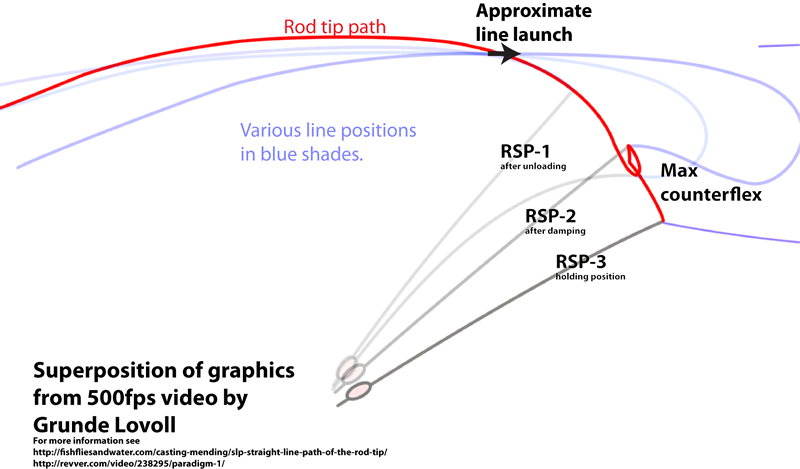
Spend some time with this string of messages between Ally Gowans and me as well as his attachment. An interesting way of looking at the way a fly line is cast. Ally's original message in plain type. My comments in italics. His return in green. G.
~~~~~~~~~~~~~~~~~~~~~~~~~~~~~~~~~~~~~~~~~~~~~~~~~~~~~~~~~~~~~~~~~~~~~~~~~~~~~~~~~~~~~~~~~~~~~~~~~~~~
Hi
Gordy,
In an attempt to remove
smokescreens and red herrings and keep it simple!
It is unnecessary to
consider any part of a fly rod other than the tip ring during a
cast.
Well... there are a lot of things the caster must do to make the tip ring do what it does (???) G.
True and how the cast
is made depends on style, the rod etc but essentially assume constant line
length and to make the ?same? cast the tip ring must do the ?same? thing
regardless of the machine that drives it. I am not discussing how the tip ring
is propelled but how the fly line is cast. We actually don?t ?cast? rods we cast
with rods! This consideration eliminates rod action, translation, rotation
etc. AG .
For simplicity assume a
?straight line? cast (line straight and tip ring travelling straight and
horizontal).
By "horizontal" do you mean casting in the horizontal casting plane? G.
The plane really does
not matter but for simplicity I encourage you to think of the rod travelling in
a ?vertical? plane. I wanted to make clear that the line is arranged perfectly
in a ?straight line? aligned with the rod tip which also travels in a ?straight
line? so that it was clear where the line inertia was situated in relation to
the tip. AG.
While the line is being
accelerated tip ring and fly line velocity is
identical.
Yes. Seems they would have to be the same unless line is being slipped through the ring such as when hauling. G.
Again for simplicity I
did not specify a haul. AG.
At some point the
velocity of the tip ring changes (typically it is rotated). The line continues
to travel ?straight? according to its momentum. This is the maximum velocity
attained by the line.
At the instant when the
line and rod tip velocities differ the loop starts to form. In its embryonic
state the loop is not visible to the naked eye and development of the loop
during a smooth cast is likely to be relatively slow because divergence of the
line and tip path velocities is gradual.
Therefore loop
formation commences at maximum line inertia.
That would still be close to RSP, wouldn't it ? G.
It may do if the line
is short because in that case the line inertia is centred close to the rod tip.
Hence presentation casts are easier with relatively short lines. It would not be
close to RSP in other cases such as the one that Dennis pointed out recently and
which I pointed out previously (see attached) where the line direction is not
close to RSP. The problem with deciding on where loops form is that if the rod
tip and the line travel close together for a distance it is very difficult to
see the deviation (e.g. this is when you feel that you made a smooth cast). We
first see the loop long after it has formed and when it has become clearly
visible. AG.
Centre of gravity of
the load (fly line) is function of line length and mass distribution. A short
line follows the rod tip more closely as it rotates whereas a long line is
influenced much less by rod rotation.
The casting stroke
starts immediately the tip ring increases line velocity and ends at maximum line
velocity.
One way of defining the start and finish of the CASTING STROKE. Has merit, I think. G.
I used ?velocity?
here because I thought that for this case it would be better understood,
correctly I could have used inertia and if a haul was used I would include the
inertia so generated. Haul energy can substitute stroke energy within limits.
AG.
Maximum rod tip speed
is not important unless it coincides with maximum line velocity. During many
casts maximum line velocity occurs when a cord drawn between the handle and tip
ring is about 90 degrees to the line after which the caster senses the load
lightening and stops the rod. This is more noticeable on long casts than short
casts because a short line follows the tip ring more closely due to closer
coupling to the line inertia.
Joan Wulff has pointed that out using different words during her Instructor Course. (Except for the caster stopping the rod in response to sensing the lightening of the load. I'll have to think about that one as I cast in the morning.) G.
OK if you want to
test this put a long line out straight and make the stop on the next cast using
more arc than usual (down to horizontal?). Unless you managed to increase the
angular velocity considerably after the 90 deg cord angle the load will reduce.
Useful energy transfer to the line is impossible if the rod is rotated to the
point when the rod and line are aligned. Please be careful and don?t use a
hook! AG.
Usually as the tip ring
approaches RSP it will not be burdened by significant load (because it has
ceased to energise the line apart from a very small amount close to the rod tip)
and so its high speed is fairly irrelevant to the cast but it can distort the
rod leg of the loop due to counter-flex and rebound.
Fits
with the concept that what happens prior to RSP affects the fly leg of
the loop, whereas what happens after RSP affects mainly the rod
leg.
Gordy
Hope that this makes it a little clearer and coincidentally I noticed a piece in your previous group message that suggested something similar to this. Ally
Best
regards,
Ally Gowans
~~~~~~~~~~~~~~~~~~~~~~~~~~~~~~~~~~~~~~~~~~~~~~~~~~~~~~~~~~~~~~~~~~~~~~~~~~~~~~~~~~~~~~~~~~~~~~~~~
From Aitor Coteron :
Hi Gordy,
I've been reading the interesting attachment by Walter Simbirski. Just a clarification. Walter wrote:
"Now we have some very insightful statements from Aitor about static vs dynamic rod loading and bending profiles along with the question about how we can achieve maximum acceleration when the applied force/torque is constant... As a simplification the point of maximum load is also the point of maximum line acceleration."
Well, when I wrote about acceleration I was thinking of rod butt acceleration, not line acceleration.
The reason is that thanks to the CA rod butt acceleration can be known, while acceleration of the line remains out of our reach as fly casting instructors; moreover when Bruce says that the goal of a good casting stroke is to have a constant acceleration he is talking about rod butt acceleration as deducted from the CA measurements. Is in this context that there isn't a maximum acceleration of the rod butt on a cast whose smoothness ratio nears 1, since that indicates that acceleration is practically constant.
Regards,
Aitor=
~~~~~~~~~~~~~~~~~~~~~~~~~~~~~~~~~~~~~~~~~~~~~~~~~~~~~~~~~~~~~~~~~~~~~~~~~~~~~~~~~~~~~~~~~~~~~~~~~~~
From Jim Bass :
Gary &
Gordy
The very nature
of the word acceleration is to increase the speed of anything. The two words we
are considering are Adjectives Descriptive words. I for one do not think
you need to add anything to the base word. In my thinking the more
adjectives we use the more opportunity we have of confusing our students.
The old KISS applies here. I believe you know what accelerate to a stop means.
You do not gain a great deal of information from constantly continue to
accelerate to a stop. We tent to make much of our instructions to
wordy.
For what it is
worth. Best, Jim
Attachment:
supermiposed_slp_web.png
Description: PNG image