[Date Prev][Date Next][Thread Prev][Thread Next]
Thread Index
Date Index
Subject Index
Loops / Roll casts
- Subject: Loops / Roll casts
- Date: Tue, 30 Mar 2010 10:35:39 -0400
Walter & Group...
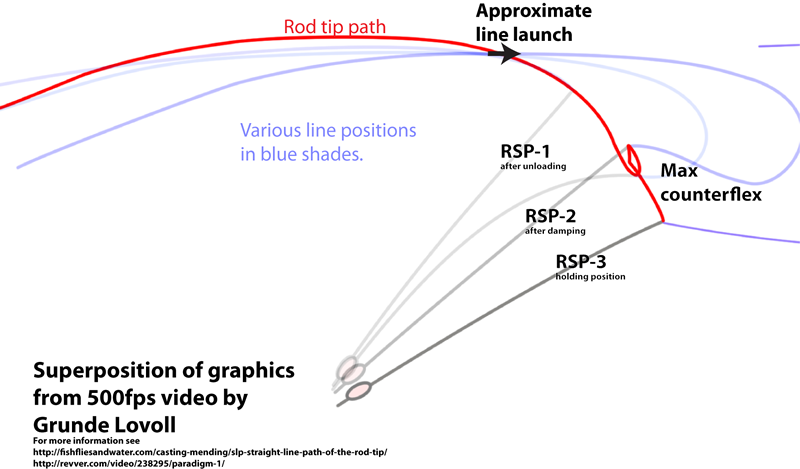
On loop formation from Ally Gowans . I
included his attachment. G. :
Hi
Gordy,
The attached sketch may
help to explain something of loop formation. The line trajectory after the rod
is unloaded I think is the resultant of the combination of the line?s inertia
and the force applied to the line by the rod tip before unloading (and of course
external influences, drag, gravity, wind etc.).
Best
regards,
Ally
Gowans
~~~~~~~~~~~~~~~~~~~~~~~~~~~~~~~~~~~~~~~~~~~~~~~~~~~~~~~~~~~~~~~~~~~~~~~~~~~~~~~~~~~~~~~~~~
Pete Greenan refers to my comments on the delay of
rotation relating to loop size when roll casting :
Gordy & all,
Looking at Ally Gowens articles and teaching
methods I see the trajectory of the roll/dynamic cast to be aligned with the
"rod leg", i.e. from low in the back to high in the front. If you delay
the rotation until the end of the translation you will "flatten" the trajectory
to a degree that allows a tight loop directed at the target.
I hope I explained that so everyone can understand
what I mean. It is better described in Ally's work.
Pete Greenan/Florida
~~~~~~~~~~~~~~~~~~~~~~~~~~~~~~~~~~~~~~~~~~~~~~~~~~~~~~~~~~~~~~~~~~~~~~~~~~~~~~~~~~~~~~~~~~~~~~~~~
Pete ... Clear to me.
G.
~~~~~~~~~~~~~~~~~~~~~~~~~~~~~~~~~~~~~~~~~~~~~~~~~~~~~~~~~~~~~~~~~~~~~~~~~~~~~~~~~~~~~~~~~~~~~~~~~~
Juergen Friesenhahn provides another way of
looking at the acceleration of the cast. (OH = Overhead )
G.:
Gordy,
I always teach, that there is no difference in the forwardmotion of an
OH-Cast or a static/dynamic Rollcast.
The only difference I see personally is the way I load the rod.
If you have a sufficient mass behind the rod and control over the anker
(short lift to move the line and Point-P),
there is no need to power more, than in an OH-Cast.
(This is true, as long you are not trying to do rollcasts way outside the
belly.)
Loopsize is controlled by the tip path, but primarily for the "average
student" done by the high stop.
I also always teach constant acceleration and late rotation.
Rodtip as long as possible behind the hand, late rotation and power.
Mathias Lilleheim allowed me to use his "visible idea" of the
loadingprocess, seen here:
Z is increasing speed, A is the late rotation and P is the definite
stop.
Also a "good sounding" example!
zzzzzzzzzzzzzzzzzzzAP
~~~~~~~~~~~~~~~~~~~~~~~~~~~~~~~~~~~~~~~~~~~~~~~~~~~~~~~~~~~~~~~~~~~~~~~~~~~~~~~
Juergen :
I
like that !
Gordy
~~~~~~~~~~~~~~~~~~~~~~~~~~~~~~~~~~~~~~~~~~~~~~~~~~~~~~~~~~~~~~~~~~~~~~~~~~~~~~~
Bruce Richards comes in with a candid answer to our questions about
the roll cast (CA = Casting Analyzer) :
Hi Gordy,
Because the CA picks the middle cast of about 5
false casts to analyze it is difficult to analyze roll casts. I haven't done it,
but do have a thought on roll cast acceleration.
The best roll casts do have rather tight loops,
compared to the rather big round loops many beginners throw.
To get a tight loop, the rod tip must travel
in a fairly straight path, during the casting stroke. Below, Mark mentions the
slow hand translation that brings the rod to the right position to start the
roll cast. That is not part of the casting stroke so can't be considered in the
acceleration picture.
Just as drag in an overhead cast is not part of the
casting stroke. But, once significant acceleration starts, it should be as
constant as possible as that is what results in progressive rod bend and a
straight(er) tip path.
Next time I'm out with the CA I'll try to do some
roll casts. What will show is a bunch of creep that would be slow rotation to
bring the rod to the proper "start" position, followed by fairly constant
acceleration, assuming the cast is good. I
think.........
Bruce
Attachment:
supermiposed_slp_web.png
Description: PNG image